Getting children to sleep is one of the most searched parenting topics on the internet, and it’s worth understanding why: it’s a problem that is genuinely solvable for most families, but the solution requires consistency in a way that’s harder than it sounds.
The good news is that the underlying mechanisms are well understood. Sleep is not a behaviour that children choose, it’s a physiological process that the right conditions trigger. Your job as a parent isn’t to force your child to sleep; it’s to create the conditions under which sleep happens reliably. Once you understand that distinction, the whole project becomes more tractable.
This guide walks through the evidence-based approach to children’s sleep from first principles, what sleep researchers actually know, how to build a routine that triggers sleep reliably, and how to adjust for age, temperament, and the specific failure modes most families encounter.
Why Children Resist Sleep: The Real Reasons
Before building a solution, it’s worth understanding what’s actually happening when a child resists bedtime. The resistance almost always has a cause, and the cause determines the fix.
Cause 1: The Child Isn’t Tired Enough
This sounds obvious but is frequently missed. Children’s sleep needs vary significantly by age, and bedtimes that worked at three often stop working at five simply because the child’s sleep need has decreased. A child being put to bed at 7pm when they genuinely won’t be sleepy until 8:30pm isn’t misbehaving, they’re not tired. The fix isn’t more enforcement; it’s a later bedtime.
Sleep need by age (approximate, from the American Academy of Sleep Medicine):
- Ages 3–5: 10–13 hours
- Ages 6–12: 9–12 hours
If your child is taking forty-five minutes to fall asleep and waking at the same time each morning, their bedtime is probably too early for their current sleep need. Try moving it fifteen minutes later and monitor for two weeks before adjusting further.
Cause 2: Too Much Stimulation at the Wrong Time
The brain is not a switch. It can’t go from high engagement to sleep in fifteen minutes. Children who are playing video games, watching television, or engaged in rough physical play at 7:30pm and expected to be asleep by 8pm are being asked to make a physiological transition that takes most children 45–90 minutes.
Screens are a particular problem because blue-light-emitting displays suppress melatonin production, the hormone that signals sleep readiness. The research on this is consistent and strong: screens in the hour before bed delay sleep onset in children as well as adults.
The fix is wind-down time: a period of at least 30–45 minutes before bed where stimulation is actively reduced. Dim lights, quieter activity, no screens. The bedtime routine starts earlier than most parents realise.
Cause 3: Inconsistency
Children’s nervous systems are extraordinarily pattern-sensitive. A bedtime routine that is exactly the same every night — same order, same cues, same timing — becomes a sleep trigger over time. The child’s body begins preparing for sleep before the routine even starts, simply because the cues are familiar.
A bedtime that varies by 30 minutes each night, in different orders, with different activities, doesn’t trigger this anticipatory response. The child has to start from scratch each night. This is far more tiring for both the child and the parent.
The fix is mechanical: do the same things in the same order at the same time. This is almost always harder for parents than for children. Life is variable. But the investment in consistency pays enormous dividends within two weeks.
Cause 4: The Routine Triggers Anxiety Rather Than Calm
Some children resist bedtime not because they’re not tired, but because they’re anxious about being alone, about the dark, or about something specific in their life. This is different from garden-variety bedtime resistance and requires a different response.
Signs that anxiety is the primary driver:
- The child is clearly tired but becomes more distressed as bedtime approaches, not less
- Fears are specific and articulate (“What if someone comes in?” “What if I have a bad dream?”)
- The resistance escalates over time rather than resolving with consistent routine
- The child is experiencing heightened anxiety in other contexts too (school transitions, separations)
For anxiety-driven resistance, the solution involves both routine (which provides predictability and therefore safety) and direct engagement with the fear. Dismissing fears (“There’s nothing to be scared of”) rarely helps. Acknowledging them and building in a concrete coping strategy usually does.
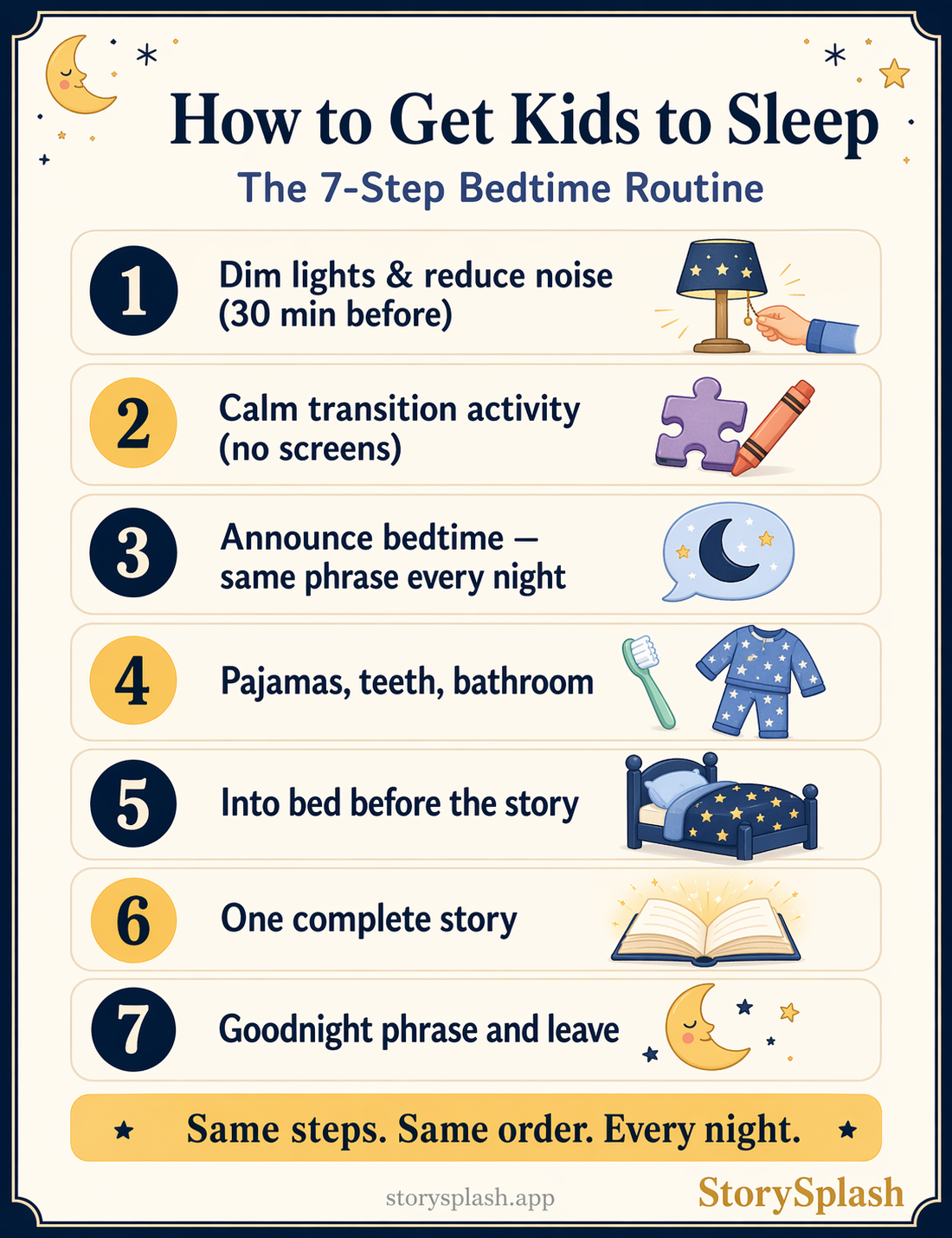
The 7-Step Bedtime Routine That Works
This routine works for most children between ages 2 and 9. It takes about 30 minutes when functioning well. It is entirely ordinary, the power is in the consistency, not in any single element being special.
Step 1: Environment Preparation (30 Minutes Before)
Before you say anything to your child about bedtime, dim the lights in common areas. Reduce sound — turn off the television, bring the music down. Lower the temperature slightly if possible (the body falls asleep more easily at cooler temperatures).
This environmental shift is a signal to the nervous system before it’s a signal to the child. Children whose homes become quieter and dimmer before bed enter the wind-down window without a fight, because the environment is doing some of the work.
Step 2: Transition Activity (15–20 Minutes Before)
Shift your child to a calm, low-stimulation activity. Colouring, puzzles, quiet play, or reading quietly together all work. The goal is to bring high-energy activity to a natural close rather than requiring an abrupt stop.
This is where screens need to end. If your child watches television or uses a tablet as part of their evening, build in a thirty-minute gap between screen time and the start of the bedtime sequence.
Practical note: Give your child a two-minute warning before this step. “Two more minutes, then we start getting ready for bed.” Children who are surprised by transitions resist them; children who have been prepared accept them more easily.
Step 3: The Bedtime Announcement
Use the same phrase every night to signal that the bedtime sequence is starting. It doesn’t need to be elaborate. “Time for bed, let’s go” in a warm but matter-of-fact tone. The same phrase, consistently, becomes a conditioned sleep cue within two weeks.
What doesn’t work: negotiations, variations, enthusiasm, or any tone that suggests bedtime is optional. Bedtime is not a proposal.
Step 4: Hygiene Steps
Pajamas, teeth, bathroom, in the same order every night. These mundane steps are actually valuable in the routine’s architecture because they are reliably boring. Boring is good here. Boring means the nervous system is winding down.
Give children agency within this step where possible, which pajamas tonight, which toothpaste flavour, but not over whether the step happens. The choice is between two acceptable options, not between doing it and not.
Step 5: Into Bed
The child is in bed before the story starts. Not on the sofa, not in your arms. In their own bed. The location is part of the sleep association that makes independent sleep possible.
If your child typically falls asleep on the sofa and is carried to bed, you will notice that they wake when moved (because the sleep cue, your arms, the sofa — is no longer present) and struggle to settle. Getting into bed before the story is a small step with a significant impact on the night.
Step 6: One Story
A single, complete story. This is the most important element of the routine and the one most parents get wrong by making it too long, too exciting, or too open-ended.
The story should:
- Be complete, a beginning, middle, and clear end
- Have a calm final beat, the hero is home, the adventure is done, everyone is safe
- Not have a cliffhanger that the child’s brain will spend the next hour processing
- Run for 5–10 minutes for under-8s, up to 15 minutes for older children
The story ends. It does not continue. It does not lead to another story. The child who asks for “one more” should receive the same kind answer every time: “That’s our story for tonight. Sleep tight.” Predictable refusal is not unkind, it’s reassuring. The child learns that the routine is reliable, which makes sleep feel safe.
For the story itself, a personalised story generates the highest quality engagement, a child who is the protagonist of tonight’s story is paying a qualitatively different kind of attention than a child watching characters they don’t particularly identify with. That engaged, then resolved attention is the ideal precursor to sleep. See our full guide to calming bedtime stories for kids for what makes a story effective specifically at bedtime.
Step 7: Goodnight Phrase and Exit
The same phrase, every night, as you leave. “Sleep tight, I’ll see you in the morning.” “Goodnight brave one, dream big.” Whatever feels natural to you, the content doesn’t matter; the consistency does.
Then leave. Confidently and consistently. Uncertainty in the exit (hovering, one more check, one more drink of water) teaches children that lingering is available if they just resist long enough. Confident exits, repeated every night, teach children that the routine ends and sleep begins.
Age-Specific Adjustments
The 7-step routine works across ages, but the details need adjustment.
Ages 2–3: Shorter, More Physical
At two and three, children are still developing the language to understand and negotiate routine. The routine needs to be very short (under 20 minutes), with a high sensory component — bath, warm pajamas, skin contact during the story. The story itself should be simple: 5 minutes maximum, repetitive language, familiar characters.
The biggest challenge at this age is consistency from the parent’s end. Two-year-olds don’t yet understand why the routine exists; they just need it to happen. The explanation doesn’t help, the repetition does.
Specific adjustment: Bath is worth including in the under-3 routine if possible. The drop in body temperature after a warm bath actively promotes sleep onset. For older children, it’s optional; for toddlers, it’s one of the most reliable physiological sleep aids available.
Ages 4–5: Give Them Role in the Routine
At four and five, children are in a major push for autonomy. They want to choose. The resistance at bedtime at this age is usually about control, not tiredness. The solution is to build choices into the routine rather than removing choice entirely.
Which pajamas. Which story theme. Which goodnight phrase. These micro-choices give the child agency within a structure that doesn’t actually change. The routine remains fixed; the experience of the routine shifts from “this is happening to me” to “I am part of this.”
This is the age when a story about the child themselves, where their choices actually shape the narrative — becomes most powerful. A child who chose “a story about me in a forest” and then hears exactly that story has experienced genuine agency, which matters considerably for bedtime cooperation.
See our guides on bedtime routine for 4-year-olds and bedtime routine for 5-year-olds for age-specific detail.
Ages 6–7: The Routine Becomes Self-Propelled
At six and seven, children who have had a consistent routine often start moving through it without prompting. The cues are so established that the child’s body is doing most of the work. This is the goal, and it’s a genuine pleasure to see, a child who brushes their teeth and gets into bed and asks for the story without a single reminder.
If this hasn’t happened by age 6–7, the routine hasn’t been consistent enough. It’s not a character issue; it’s a pattern issue. More consistency now will still work.
Specific adjustment: At this age, children can begin managing parts of the routine themselves. They can set out their pajamas at the start of the evening. They can turn off their bedside light after the story. Building in that independence gives them ownership of the routine rather than just compliance with it.
Ages 8–9: Negotiate the Bedtime, Not the Routine
By eight and nine, children are old enough to understand sleep need and old enough to feel the unfairness of a bedtime they consider too early. This is worth taking seriously rather than dismissing.
Negotiate the bedtime, not the routine. “If you go through the whole routine without any delay three nights in a row, we can try moving bedtime fifteen minutes later.” This approach treats the child as a participant in their own sleep management, which is appropriate at this age and reduces resistance significantly.
The routine itself — hygiene, story, goodnight — remains non-negotiable. But the time at which it starts can be a reasonable subject of age-appropriate negotiation.
See our guide on bedtime routine for 7-year-olds for additional adjustment points.
The Sleep Environment
The bedroom environment contributes significantly to sleep quality, and parents frequently underestimate it.
Light: The bedroom should be as dark as the child can tolerate. Blackout blinds are worth the investment for families who struggle with early waking (particularly in summer) or late settling. A dim nightlight is fine for children who need some light; a screen of any kind is not an acceptable light source at night.
Temperature: Cool is better than warm for sleep. 16–20°C (61–68°F) is the optimal range. A warm child in a warm room takes longer to fall asleep.
Sound: Many children sleep better with consistent background sound (a white noise machine, a fan) than in silence, because silence makes every creak and voice in the house audible. Consistent, uninteresting background sound masks those interruptions.
The bed: The bed should be primarily for sleeping, not for playing, watching television, or doing homework. The stronger the association between the bed and sleep, the more readily the brain shifts into sleep mode when the child gets in.
The Story’s Role in Getting Children to Sleep
The bedtime story is not an optional add-on to the routine. For most children, it is the most powerful element, the one that most reliably triggers the shift from alertness to sleepiness.
This works because a well-matched story engages the child’s imagination fully enough that all the earlier restlessness (the physical fidgeting, the mid-routine protests) quiets down. The child is paying attention to something more interesting than their resistance. And then the story ends, the engine is switched off, and the quietness that follows is ready to become sleep.
The story needs to end, not trail off. A story that’s still going when the child falls asleep teaches the child to fall asleep with the story still happening, and when they wake naturally at 11pm and the story is gone, they often need it back. A story that ends cleanly before the child is fully asleep teaches the child to bridge the final stretch to sleep independently.
For evidence on what makes a bedtime story specifically calming rather than stimulating, see our complete guide to calming bedtime stories for kids.
When the Routine Falls Apart
Travel, illness, late events, school disruptions, the routine will fall apart periodically, and the recovery matters.
The instinct is to compensate: extra stories to make up for the late start, a more relaxed routine because everyone is tired, screen time as a shortcut to the settled place. These strategies make the immediate night slightly easier and the following week significantly harder.
The better approach is a compressed version of the full routine. Even pajamas, teeth, a five-minute story, and a goodnight phrase takes ten minutes. That compressed routine is far better than abandoning the routine entirely, because it keeps the signal chain intact. The child’s nervous system still recognises the sequence.
One thing worth protecting even on difficult nights: the story. A very short story on a hard night is better than no story. It’s the most powerful sleep cue in the sequence, and removing it removes the best tool you have.
Common Mistakes Worth Avoiding
Starting the bedtime routine too late. By the time most children are visibly tired, they’re already past the optimal sleep window. Start the wind-down earlier than feels necessary.
Inconsistency in the exit. Lingering, extra checks, responses to calls for water, each of these extends the routine and teaches the child that persistence is rewarded.
Escalating stimulation to achieve compliance. “Just one more game and then bed”, the game re-activates the nervous system and makes the bed transition harder, not easier.
Treating weekends differently. The routine is only powerful if it’s truly consistent. A wildly different weekend schedule resets the cue-learning by Monday and the family spends the first half of the week rebuilding it.
Making the story interactive in a way that increases alertness. Discussion, prediction, active engagement are wonderful — just not immediately before sleep. The story should end with the child in a quiet, receptive state, not a stimulated one.
The Connection Between Daytime Activity and Nighttime Sleep
One of the most reliable predictors of good nighttime sleep is adequate physical activity during the day. Children who have been genuinely physically tired from outdoor play, sport, or active indoor games fall asleep more easily and sleep more deeply than children who have spent the day primarily sedentary.
This isn’t a moral claim about screen time, it’s a straightforward physiological one. Sleep pressure builds in part through physical exertion during waking hours. A child who has not moved much during the day simply hasn’t built the same sleep pressure as a child who has.
Practical implications:
- If bedtime is consistently difficult, look at the whole day before looking at the bedtime routine. Have the last two hours before bed been primarily sedentary? Has the child had at least 60 minutes of active outdoor time today?
- Timing matters. Physical activity in the late afternoon (two to three hours before bed) is excellent. Vigorous exercise within an hour of bedtime can delay sleep onset in some children, because the physiological arousal takes time to clear.
- Outdoor light exposure during the day also supports better nighttime sleep by helping regulate the child’s circadian rhythm. This is particularly relevant in winter months when children may spend full days indoors.
None of this means a child who had a quiet, indoor day can’t fall asleep. But if bedtime difficulty is chronic and the daytime picture is sedentary, addressing the daytime activity level is often faster-acting than further bedtime routine adjustments.
The Impact of Naps on Nighttime Sleep
For children who still nap (typically under 5, though this varies significantly), the nap schedule has a direct effect on nighttime sleep quality. Too long a nap, or a nap taken too late in the afternoon, can substantially delay nighttime sleep onset.
A 2-year-old who naps from 2pm to 5pm and is expected to sleep at 7pm is being asked to sleep after only two hours of wakefulness. Most 2-year-olds simply can’t do this.
General nap guidance:
- The nap should end at least 3–4 hours before bedtime
- If the child is fighting the nap consistently, it may be time to drop it, this typically happens between ages 2 and 5
- If dropping the nap entirely causes too much late-afternoon difficulty, try a 20-minute “rest” rather than a full sleep, which reduces sleep pressure less dramatically
When transitioning away from naps, expect a period of 2–3 weeks where bedtime is significantly earlier (the child may need to go to bed at 6pm to compensate for the lost nap sleep). This isn’t a permanent adjustment, the earlier bedtime gradually shifts back as the child adapts.
Managing the “Curtain Calls”: What to Do About Last Requests
“I need water.” “I forgot to tell you something.” “I need another hug.” “There’s a noise outside.” “My pajama leg feels funny.”
These post-bedtime requests are so universal they have their own nickname among paediatric sleep researchers. Understanding them makes them easier to handle.
The curtain call is usually not about the stated need. It’s about maintaining connection and postponing sleep. The child has learned, usually quite accurately, that specific requests produce specific parental responses. Water gets a parent to come back. A question about tomorrow gets five minutes of conversation. A stated fear gets extended comfort.
The response that resolves curtain calls fastest is the one that makes them unrewarding without being unkind. A few strategies:
Pre-empt them. Before you leave, name the common requests: “Before I say goodnight — is there anything you need? Water? One more hug? Anything to tell me?” This gives the child a legitimate final-request opportunity and removes the need for the post-lights-out version.
Give one genuine response to one genuine need. Water is a real need. Give it once, warmly, without frustration. Then make it clear: “That’s our last trip tonight.” And mean it.
For repeated curtain calls: Return the child to bed with minimal engagement. No extended conversation, no negotiated exceptions. The tone is warm but matter-of-fact. “It’s sleep time. Goodnight.” This isn’t harsh, it’s predictable, and predictable is safe.
The curtain call phase typically resolves within two weeks of consistent management if it’s being maintained by parental response. If it persists beyond that, it’s worth looking at whether the underlying bedtime anxiety is greater than typical.
When to Talk to a Doctor
Most children’s sleep difficulties resolve with consistent routine implementation. But some sleep problems have physical causes that routine alone won’t address.
Talk to your paediatrician if:
- Your child consistently snores loudly or pauses breathing during sleep (possible sleep apnoea)
- Your child has frequent night terrors, not nightmares, but true night terrors with eyes open, not responsive
- The sleep problem persists unchanged after six weeks of genuine, consistent routine implementation
- Your child is excessively sleepy during the day despite apparently adequate night sleep
- There are signs of significant anxiety that extend well beyond bedtime
These are not common, but they’re real, and they require assessment rather than more consistent routine.
For the large majority of families, though, the answer to getting children to sleep reliably is simpler than it seems: start earlier, be consistent, make the story the best part of the night, and leave confidently. Repeat for two weeks. It works.
For a quick-reference version of the routine to post on your child’s bedroom door, see our bedtime routine chart for kids, a free printable that walks through the sequence in child-readable form.