Three-year-olds don’t fight bedtime because they’re difficult. They fight it because the world is genuinely fascinating and stopping feels like losing.
The solution isn’t to fight back. It’s to make bedtime feel like something that happens with them — with a story at the center that makes going to bed feel worth it.
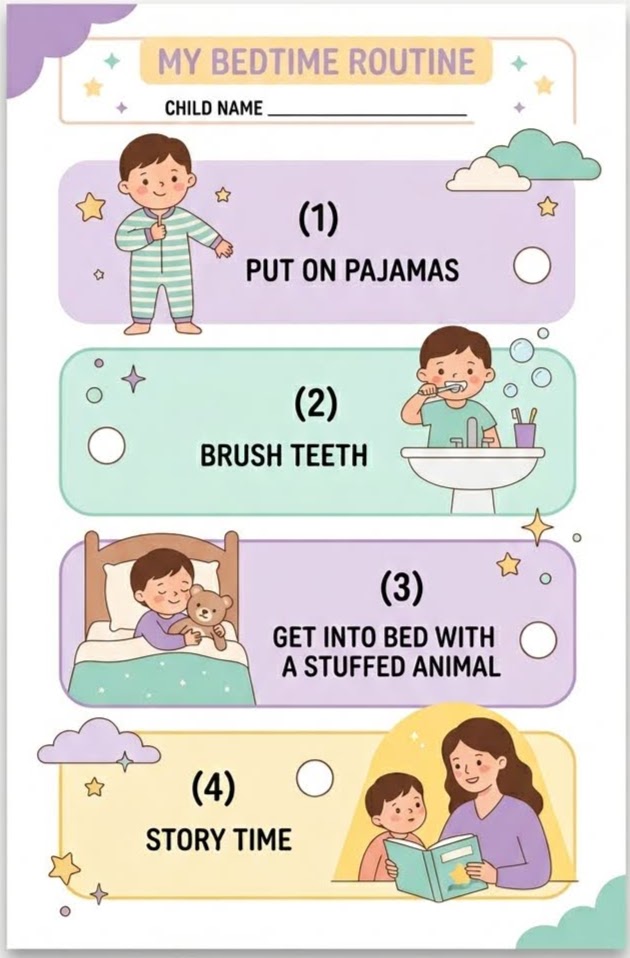
There’s a free printable chart below.
Why 3-Year-Olds Need Routine More Than Rules
At three, a child’s prefrontal cortex — the part of the brain that handles impulse control and transitions — is still very early in its development. This means rules and warnings only go so far. “It’s bedtime in ten minutes” doesn’t land the way you hope because a 3-year-old genuinely cannot picture ten minutes from now.
What works instead is a predictable sequence they’ve experienced enough times to recognise. When the same things happen in the same order every night, their nervous system learns what’s coming before their conscious mind does. They start calming before the routine even begins.
Keep the sequence short — three to four steps maximum at this age. Any longer and the routine becomes a distraction event rather than a wind-down.
Practical tip: Use the same first phrase every night to start the routine. “Okay, time to get ready for your story” is gentler and more effective than “it’s bedtime” because it frames the sequence as moving toward something rather than away from play.
A 3-Year-Old Bedtime Routine That Stays Under 20 Minutes
Simple is the point. At three, a long routine is an opportunity for distraction. Four clear steps, the same order every night.
| Step | What to do | Target time |
|---|---|---|
| 1 | Put on pajamas | 3 minutes |
| 2 | Brush teeth and use the bathroom | 4 minutes |
| 3 | Get into bed with comfort item | 2 minutes |
| 4 | One calm story, then lights out | 8 minutes |
The story needs to come last. That order matters: it gives your child something to move toward through the earlier steps, and it ends the routine at the point of maximum calm. A story that ends with the main character going to sleep is particularly effective — your child’s brain mirrors the character’s wind-down.
Practical tip: Use picture-based steps on the wall if your child responds well to visual cues. Pointing to the chart is lower friction than repeating verbal instructions at every step.
What Makes a Good Bedtime Story for a 3-Year-Old
At three, the most effective bedtime stories are short, calm, and feature characters your child can identify with. The ideal story for this age has gentle stakes — nothing scary, no unresolved conflict, no open endings that leave the brain spinning.
The single most powerful element: making your child the main character. A three-year-old who hears their own name in the first sentence of a story switches from passive listening to active engagement immediately. They stop squirming. They want to know what happens to them. That switch — from distracted to absorbed — is the moment the routine starts working.
After the story ends, keep the transition clean. Same phrase every night. Close the lamp, say goodnight, leave. The predictability of what happens after the story is as important as the story itself.
Practical tip: A personalised story doesn’t have to be elaborate to work. Even a simple adventure where your child helps a friendly animal get home is enough at this age. The personalisation does most of the work.
Handling Separation Anxiety at Bedtime
Many 3-year-olds go through a phase of genuine distress at separation. This is developmentally normal — attachment is doing its job. The bedtime routine needs to account for it rather than ignore it.
The most effective approach is predictable presence followed by predictable departure. Don’t linger after the story, but also don’t vanish suddenly. A consistent leave-taking ritual — one hug, one phrase, the same action every night — teaches your child that you leave and you come back. The predictability is the reassurance.
Avoid extended negotiations, multiple returns, or lying down until they’re asleep. These provide short-term relief but extend the separation difficulty over weeks rather than resolving it. The routine only works if it has a consistent ending.
Practical tip: A comfort object — a stuffed animal, a blanket — that’s present during the story becomes associated with the safe, calm feeling of story time. That object then carries the association into the night when you’re not in the room.