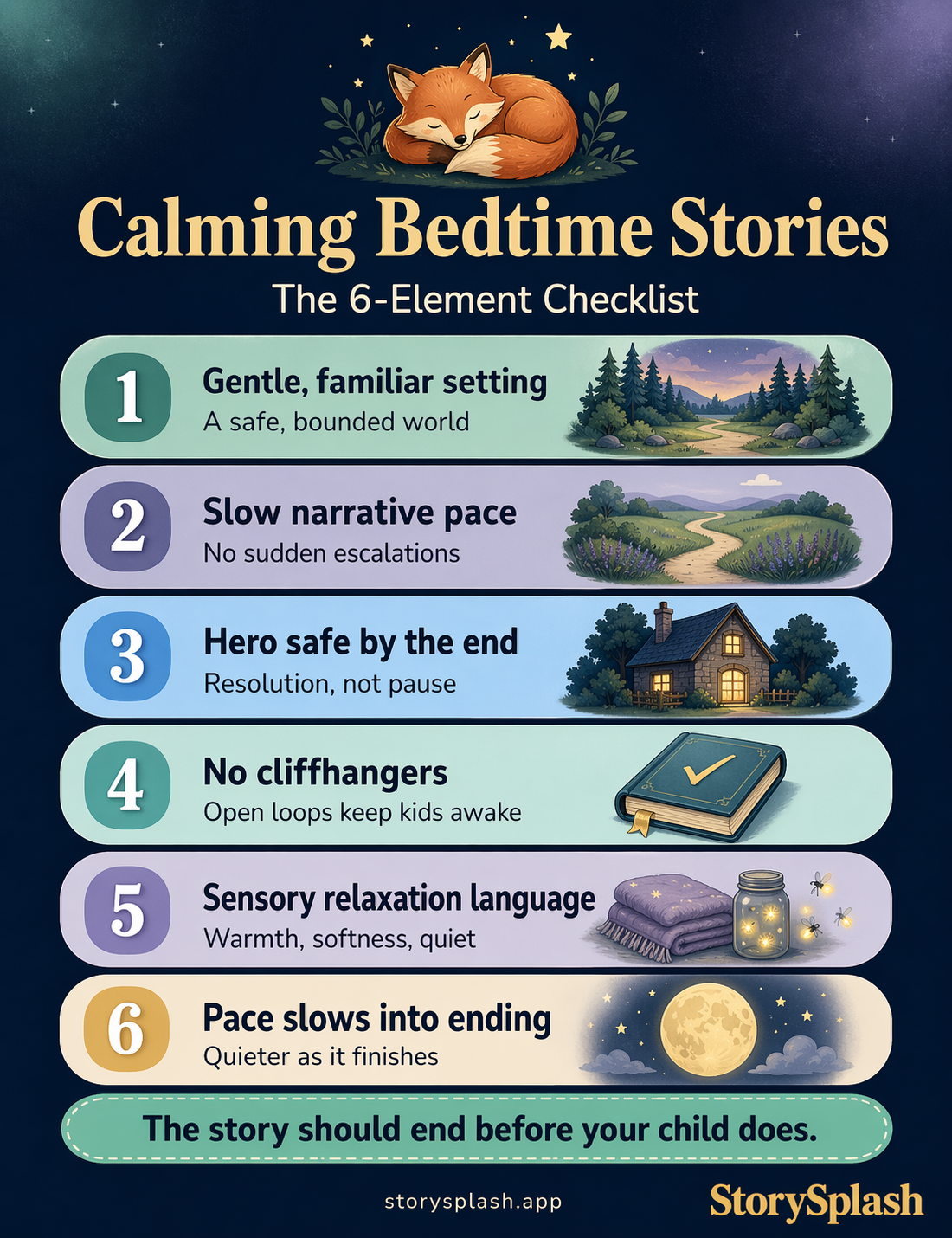
There’s a version of bedtime story that works like a switch: the child is alert when the story starts, engaged through the middle, and arrives at the end in a quiet, settled state that transitions naturally into sleep. That’s not an accident. It requires a specific kind of story, not a random story told in a quiet voice, but a story with particular structural and tonal properties that produce a particular neurological effect.
Most parents figure this out through trial and error. Some never quite crack it, and the bedtime story remains a high-energy ritual that leaves the child more awake than they started. Understanding what’s actually going on in a calming bedtime story makes the trial-and-error process much shorter.
What Happens in the Brain During a Bedtime Story
A well-matched bedtime story does something specific. It captures attention, not passively, but actively enough that the restless physical energy of the pre-sleep period has somewhere to go. The body stops fidgeting because the mind is occupied. And then the story ends, and the child’s arousal level, which was engaged but not escalated, drops naturally toward sleep.
The science here isn’t complicated. Arousal, the level of alertness and activation in the nervous system — needs to be on a downward slope going into sleep. The enemy of that slope is interruption: sudden noise, strong emotion, unresolved tension, bright light, an open question that the mind keeps returning to.
A calming bedtime story manages arousal deliberately. It holds attention (keeping the child from the restless discomfort of trying to sleep without anything to focus on), while keeping the emotional register below the level that prevents sleep.
This is why a completely boring story often doesn’t work as well as a gently engaging one. A bored child’s mind wanders; a wandering mind generates its own stimulation. The story needs to be interesting enough to occupy the child’s attention, but calm enough to lower the heart rate rather than raise it.
The Six Elements of a Calming Bedtime Story
These elements aren’t rules, they’re descriptions of what the best calming stories consistently do. Use them as a checklist when choosing or constructing a story.
Element 1: A Gentle, Familiar Setting
The setting of a calming bedtime story is doing physiological work. Described environments that evoke safety, warmth, and beauty trigger a mild relaxation response even in adults. For children, who are more imaginatively open and more responsive to descriptive language, the setting effect is even stronger.
Settings that consistently work: forests at dusk, warm kitchens, small cottages in snowy fields, quiet beaches at sunset, gardens after rain, cosy ships at anchor, meadows in late afternoon. The common element is a sense of bounded, safe space, a place that contains the characters rather than expanding infinitely.
Settings that undermine the calming effect: vast, open, dark spaces; settings associated with specific fears (hospitals, deep water for water-anxious children, heights); settings that are explicitly described as dangerous or chaotic.
The setting should be introduced early in the story and described with sensory detail: “The forest was quiet that night, and the air smelled like pine needles and cold stars, and Lily could see fireflies beginning to appear one by one between the trees.” That sentence is doing a lot of calming work, it’s visual, olfactory, and temporal (night, beginning to appear), and it orients the child in a place that feels specific and safe.
Element 2: A Slow, Deliberate Pace
Narrative pace in a bedtime story is different from pace in any other story. A daytime adventure should be fast when the action is fast; a bedtime story should be slow even when the action is important.
This doesn’t mean dull. It means that the story lingers at moments the reader would otherwise race through: the moment of decision described from multiple angles, the journey given sensory texture, the small details of the setting returned to regularly. The child is asked to move slowly through the story world, which moves them slowly through arousal toward sleep.
The trap is a story that starts calm and then escalates. A monster appears; the chase begins; the hero’s heart is pounding; the danger is very real, and now the child is at peak arousal at the point in the story where you need them winding down. The structure isn’t wrong for a different context; it’s wrong for bedtime.
Practical note for parents telling stories: If you’re improvising, slow your voice deliberately. Longer pauses between sentences. Quieter as the story progresses. Your delivery is setting the arousal level as much as the content is.
Element 3: A Protagonist Who Ends Up Safe
By the end of the story, the main character should be home, or resting, or safe in some way that the child’s nervous system can recognise as an ending.
This sounds obvious, but it’s surprisingly often missed. Stories that end with the adventure “paused” rather than completed — “and they knew their quest would continue tomorrow” — leave an open loop that the child’s mind keeps running. Stories that end with the character safely home, with the challenge resolved, and with a quiet moment of rest explicitly described, close that loop.
The specific language of the final beat matters. “And as the moon rose higher, Ella curled up in her warm bed in the tree house, and the whole forest went quiet, and she closed her eyes, and the stars watched over her all night long.” That’s not just a story ending. It’s a mirror: the child in the story is doing what the child hearing the story is supposed to be doing. That mirroring is surprisingly powerful.
Element 4: No Cliffhangers or Unresolved Tension
A cliffhanger is a deliberate attention-capture technique, it creates an open loop that the mind returns to, which is exactly what you want when you’re trying to keep a reader coming back for the next episode and exactly what you don’t want when you’re trying to help a child fall asleep.
Any unresolved tension in a bedtime story, the villain not accounted for, the friend still in danger, the object still missing, the question still unanswered — becomes a processing task for the child’s brain in the dark. Young children’s brains don’t bracket unresolved narrative the way adult brains can. They return to it.
This is why multi-episode stories at bedtime need to be handled carefully. A chapter from a longer book is not the same as a complete story, it’s likely to end mid-arc. Some children handle this fine; many don’t. If your child consistently takes longer to fall asleep on chapter-book nights, the unresolved narrative is probably a factor.
The solution isn’t to avoid longer books, it’s to choose stopping points that correspond to natural resting places in the narrative (end of a chapter with a soft landing) rather than maximum tension points.
Element 5: Sensory Language That Mirrors Relaxation
The most reliably calming bedtime stories include language that describes physical relaxation — warmth, softness, heaviness, quiet, slow breathing — in ways that invite the child’s body to mirror what’s being described.
This isn’t a new technique. It’s essentially the narrative version of a progressive muscle relaxation exercise, and it works by the same mechanism: the brain takes the described physical state as a suggestion to the body.
Effective sensory language in a calming story: “And the cosy fire made the whole room warm, and Mia’s eyes felt pleasantly heavy, and she could feel herself sinking into the soft pillows.” Less effective: “And the fire crackled with great sparkling flames that cast shadows dancing on every wall.”
Both describe a fire. One suggests warmth and heaviness; the other suggests motion and light. At bedtime, the first choice is always better.
Element 6: A Pace That Slows Into the Ending
The final fifth of a calming bedtime story should be moving at half the pace of the middle. The language becomes simpler. The sentences get shorter. The action stops entirely, replaced by observation: what the night sky looks like, what the air smells like, how the protagonist feels.
Some of the most effective story endings read almost like a lullaby in narrative form. They don’t try to resolve the last plot point dramatically; they find the character in a quiet moment after the resolution and stay there for a while, describing the stillness in enough sensory detail that the child enters it.
A practical test: read the last paragraph of the story aloud in the voice you’d use to read a story at bedtime. If your voice naturally slows and quietens, the writing is doing its job. If you find yourself speeding up toward a punch line or a revelation, the story is not designed for this slot.
Story Themes That Consistently Calm Children
Some story themes are reliably calming across ages and personalities. Here’s a guide.
The Journey Home
A character has been somewhere exciting, a forest, an ocean, another world, and is now making their way back. The adventure is over. The journey home is described in sensory detail: the familiar landmarks, the feeling of almost-there, the arrival. This theme is one of the oldest calming story structures there is. The odyssey ends with the return home, not the adventure away.
This works because the emotional arc mirrors exactly what children need at bedtime: the excitement of the day is now past, and the movement is toward rest, warmth, and safety.
Found After Being Lost
A character has been separated from someone or somewhere they love, and the story is about the reunion. This theme resonates particularly strongly with children who have experienced any form of separation anxiety, and the resolution — found, together, safe — is one of the most emotionally satisfying endings available.
The calming quality comes from the completeness of the resolution. There’s no residue, no lingering worry. The lost thing is found.
Completing a Hard Task
The character has done something difficult. The challenge is fully over. Now they rest. Stories in this structure often end with a feast, a sleep, a return celebration, some form of earned rest that mirrors what the child is supposed to be doing.
This theme is good for children who are working through a current challenge (starting school, learning something difficult, managing a social situation) because it gives them a narrative in which that kind of effort ends in genuine rest.
A Walk Through a Beautiful Place
No story, exactly — just a character moving slowly through a world described in careful sensory detail. The landscape is the content: what the light looks like, what the air smells like, what sounds are present, what the ground feels like. The “story” is more of a sensory tour.
This structure doesn’t work for every child. Active, narrative-hungry children may find it dull and disengage. For children who are naturally imaginative and responsive to language, it can be deeply calming, essentially a guided meditation in narrative form.
A Creature Finding a Place to Sleep
This is a classic very-young-child structure: an animal (a small bear, a sleepy dragon, a baby whale) has had a day and is now looking for, or arriving at, the perfect place to sleep. The story is an extended description of comfort, warmth, and settling. The character sleeps at the end. The parallel is obvious, but young children receive it without any sense of being manipulated.
This theme works best for under-5s. Older children may find it condescending; younger children find it completely satisfying.
Story Themes That Seem Calming but Aren’t
These themes trip up parents because they sound like they should work for bedtime, and then they don’t.
Extended magical battles. The magic is beautiful and the language is lyrical, but the character is in genuine danger for most of the story. The emotional register is too high.
Reunion stories where the separation is extensively described. The reunion is calming; the separation, particularly if it involves a parent leaving or disappearing, can activate anxiety that outlasts the story’s resolution.
Stories about night fears. A story specifically about a child who is scared of the dark and then overcomes their fear is well-intentioned but often actively unhelpful at bedtime, it primes the child to think about night fears exactly when you want them to stop thinking about anything at all.
Very funny stories. Laughter is physiologically activating. A story that’s genuinely funny is wonderful at many times of day; at bedtime, it produces a physiological state that’s the opposite of sleep. The children who are most delighted by a very funny bedtime story are also the hardest to settle afterwards. Save the funny bedtime stories for earlier in the evening when the goal isn’t sleep.
Stories about tomorrow. “And when she woke up the next morning, the adventure would be just beginning.” This is a setup; it primes the child for what’s coming rather than settling them into rest. The story that works at bedtime always looks backward (what the character did) or inward (how the character feels right now), not forward.
Calming Stories for Anxious Children
Some children come to bedtime with a backlog of unprocessed worry from the day. The story can help, but only the right kind of story, delivered in the right way.
For anxious children specifically:
Choose stories where the character’s worry is acknowledged. A story where the protagonist feels nervous and the nervousness is named — “Kai’s heart was beating fast as he stepped into the dark forest, because he was a little afraid” — is more useful to an anxious child than a story where the hero feels nothing but confidence. The child sees their own experience reflected, and sees that it’s manageable.
The resolution should be earned, not magical. The character faces the fear and comes through it. Not because a magical helper arrived, but because they decided to try, or they remembered something they knew, or they asked for help from a friend. This teaches the child that their own anxious feelings don’t prevent action.
Keep the emotional stakes proportionate. A deeply frightening story resolved at the end doesn’t calm an anxious child, it activates their fear response and then resolves it, but the residue of the activation often outlasts the resolution. Gentler stakes, thoroughly resolved, work better.
End with rest that feels genuinely safe. The character is home. There are people they love nearby. The scary thing is fully over. The final image is warmth and safety, not an empty resolution.
For families dealing with significant bedtime anxiety, the story is one tool alongside others, including the broader routine predictability, the consistent parent presence, and, if needed, professional support. A great story won’t resolve clinical anxiety, but it can give an anxious child a nightly rehearsal in which difficult things end well.
Building a Calming Story Library
The most useful thing you can do for bedtime is build a curated, reliable library of stories that you know work, that have produced the right response in your specific child.
This requires a little observation. Over the course of a few weeks, notice: which stories produce the calm, settled transition into sleep? Which produce alertness or delay? What’s different about them?
Common patterns parents identify:
- My child settles fastest when the main character is the same age as them
- Stories about nature and animals work better than stories about people and cities
- Stories where the hero is clearly modelled on my child (brave, or curious, or kind in the specific way my child is) produce the most engagement and the best sleep
- Stories under 8 minutes are more reliable than longer ones for our family
Your observations are the most valuable data available because they’re specific to your child. No guide can substitute for noticing what actually works in your living room.
Once you know what works, protect it. Have a rotation of reliable stories ready so that “what story tonight” is answered before you walk through the bedroom door. The preparation reduces the low-level anxiety of uncertainty on both sides.
For nights when you don’t have anything ready, or when you want a new story that meets the calming criteria without having to evaluate it first, StorySplash generates personalised illustrated stories calibrated for the bedtime slot — complete narratives with calm endings, personalised to your child’s age and preferences. The stories are designed to hit the calming story criteria rather than maximise engagement at the expense of sleep, which is a different design goal than most entertainment apps.
Pace, Voice, and Delivery
The same story told in two different ways can produce two completely different effects. Parents who master the delivery can make a mediocre story calm their child; parents who haven’t yet noticed how much delivery matters can undermine an excellent story.
The basic principles:
Slow down. Most parents read bedtime stories at a conversational pace. Bedtime stories should be slower, noticeably, deliberately slower than you’d read aloud in any other context. The pace is a signal to the nervous system as much as a delivery mechanism for the words.
Quieter as you progress. Start at a normal indoor voice and be meaningfully quieter by the end. Not a whisper, a whisper is effort. A gentle, quiet, even tone that becomes softer as the story reaches its final pages.
Long pauses at the calming moments. When the story describes a beautiful view, a warm space, a moment of rest — pause. Give the child’s imagination time to populate the image. These pauses are not dead time; they’re doing the calming work.
Match the energy of the last third. If the story has a gentle final section, your delivery should be at its calmest there. The story’s content and your delivery should be working in the same direction, both lowering arousal, both moving toward quiet.
For personalised stories where you’re not working from a set text, this delivery guidance is even more important. Your voice is the primary instrument. Used well, it does as much of the calming work as the words.
The Role of Repetition in Calming Stories
Young children, particularly those under 5, often respond better to a story they know than to a new one. This seems counterintuitive from an adult perspective: surely a new story would be more interesting? But for young children, familiarity is specifically calming. When you know how the story goes, you don’t have to work to follow it. The cognitive load drops, the anticipatory pleasure rises (“here comes the part with the fox”), and the overall effect is more settling than the uncertainty of new narrative.
This is why the classic bedtime story format for toddlers is often a beloved picture book read repeatedly until both parent and child know it by heart. The story isn’t worn out by repetition; it becomes more valuable. Each repetition deepens the child’s relationship with the characters and the world. The predictability is the point.
As children grow (generally from around 5), they need new stories more frequently to stay engaged. A 7-year-old who has heard the same story every night for a month has moved beyond finding it calming into finding it boring. The transition from “repeat familiars” to “new content needed” varies significantly by child. Watch for it: the child who starts asking for something different, or who recites the story along with you in a way that suggests they’re now on autopilot, is ready for more variety.
The practical implication: having a small library of well-loved stories for rotation (not just one, but three or four) extends the period of familiarity-as-comfort while providing enough variety to stay engaging. Rotating three familiar stories across a week is often more effective for young children than introducing a new story every night.
How Long the Story Should Be at Each Age
The question parents ask most often about calming bedtime stories is about length, and the answer is more specific than “it depends.”
For children aged 2 to 4, the ideal story runs 4 to 6 minutes. This is enough time for the child to settle into the story, follow the arc, and arrive at the resolution before losing focus or getting restless. Beyond 6 minutes, very young children often start the fidgeting and negotiating that suggests the story’s hold has been released before it’s finished.
For children aged 5 to 7, 7 to 10 minutes is the range that consistently produces the best outcomes. Long enough to feel like a proper story, short enough to end before the child is bored or overstimulated.
For children aged 8 to 10, 10 to 15 minutes is appropriate. At this age, children can sustain narrative attention for longer and benefit from more complex, developed stories. Chapter book reading at 2 chapters per night often works well here.
These are guidelines, not rules. Some children at 5 genuinely engage with 15-minute stories and settle beautifully; others at 8 still need a clean 8-minute wrap-up. The best test is observation: if your child is still and attentive at the story’s end, the length is right. If they’re restless before the end or still buzzing when it finishes, adjust accordingly.
The critical point across all ages is that the story ends before the child falls asleep, not while they’re still awake but after they’ve nodded off. A story that the child falls asleep to becomes a sleep crutch: they need the story present to fall asleep and will need it again at any overnight wake. A story that ends cleanly while the child is still drowsy but awake teaches independent sleep far more effectively.
Calming Stories Across Different Story Formats
Calming bedtime stories don’t have to be a traditional narrative. The core requirement is that they produce the right arousal curve: engaging enough to hold attention, gentle enough to lower arousal into sleep.
Several formats achieve this:
Traditional narrative (beginning, middle, end): The most reliable format for most children. The story arc provides both engagement and resolution, which is exactly the pattern the brain needs at bedtime.
Guided imagination stories: The storyteller describes a journey or landscape in sensory detail, inviting the child to imagine themselves there. “Let’s go somewhere special tonight. Close your eyes. Imagine you’re walking along a warm, sandy path, and the air smells like the sea, and you can hear the waves…” This format requires the child to actively generate imagery, which is calm cognitive work and often leads naturally to sleep.
Character reflection stories: The story follows a familiar character (one the child already knows and loves) through a quiet day or a gentle adventure, ending with that character at rest. Because the child already has a relationship with the character, the cognitive work of building that relationship is already done. The story can go slowly and softly from the beginning.
Short poetry or song: For very young children especially, a familiar poem or lullaby can be more effective than a story. The rhythmic, predictable structure of verse is deeply calming, and the repetition across nights builds a powerful sleep association.
For parents interested in adding variety without constructing new stories from scratch, personalised bedtime stories offer a format that combines the familiarity of a known protagonist (the child themselves) with fresh narrative content, which gives you both engagement and the comfortable-character effect.
The Relationship Between the Story and the Routine
The calming bedtime story doesn’t work in isolation. It works as the final, most powerful element of a bedtime routine that has already been doing wind-down work for 20–30 minutes.
A child who has been on screens until five minutes before the story starts will not be in the right state to receive a calming story. A child who has been in a warm room with dim lights doing quiet activity for 30 minutes, who has gone through the familiar hygiene steps, who is in bed before the story starts, that child is already partway to sleep before you’ve said a word.
The routine and the story are a system. The routine creates the right conditions for the story to land; the story completes the transition the routine began. Neither one works as well alone.
For the full architecture of the bedtime routine that sets up the calming story slot effectively, see our complete guide to how to get kids to sleep. For a broader look at the types of stories that fit different moods and occasions, not just bedtime — see our guides to fairy tales for kids and adventure stories for kids, which can inform your daytime and weekend story choices while you reserve the calming story structure specifically for nights.