Ask a group of five-year-olds what story they want tonight and a significant number will say “a princess story.” This has been true for generations, and it isn’t going away. The question parents face isn’t whether to engage with the genre, but how to engage with it well.
The reputation of princess stories is complicated, they’ve been blamed for everything from body image issues to passivity to narrow aspirations. Some of those critiques land. A lot of them flatten a genuinely varied genre into the weakest examples of it, and in doing so, they deny children access to some of the most compelling stories available to them.
This guide is about using princess stories well. Not sanitising them, not banning them, not tolerating them grudgingly — using them as the powerful narrative tools they can be.
Why “Princess” Still Resonates — And Why That’s Exactly Right
The appeal of princess stories to young children isn’t mysterious if you think about what a princess actually represents to a four-year-old. A princess is:
- A child who is treated as important
- A person who has a special role in the world
- Someone who lives in a beautiful, abundant place
- A figure who can make decisions that affect everyone around her
- A person whose existence matters
Every child wants all of those things. The fantasy isn’t specifically about the dress or the castle (though those are pleasant accessories). It’s about mattering — having a defined, valued role in a world that takes you seriously.
That’s a universal desire, and princess stories are one of the ways four-year-olds know how to articulate it. “I want to be a princess” often means “I want to matter, I want to be important, I want to be seen.” Dismissing the genre is, in a sense, dismissing the desire underneath it.
The problem isn’t that children love princess stories. The problem is a narrowed version of those stories, one where mattering means being pretty, being good, and waiting for a man to validate you. Those stories deserve the criticism they get. But they’re not the whole genre, and they don’t have to be what your child hears.
What Modern Princess Stories Look Like
The princess narrative has been evolving for at least thirty years, and the most interesting versions look quite different from the classic template.
Modern princess protagonists are far more likely to:
- Have a specific skill, knowledge base, or trait that drives the plot (not just beauty or goodness)
- Solve their central problem through their own action
- Have meaningful friendships and relationships that don’t involve romantic rescue
- Be explicitly described as brave, clever, curious, or determined
- Face a moral dilemma, not just a physical obstacle
- Disagree with authority and be vindicated in doing so
- Exist in a world that has more complexity than pure evil versus pure good
Think of Princess Merida in Brave, the central conflict is between her and her mother, and the resolution requires her to understand a perspective she initially dismissed. Or Princess Cimorene in Patricia Wrede’s Dealing With Dragons, who finds the expected princess narrative so boring and limiting that she voluntarily goes to work for a dragon. Or Princess Mia in The Princess Diaries, whose story is fundamentally about self-acceptance under social pressure.
These aren’t compromise positions, stories that smuggle in a feminist message to offset a problematic form. They’re legitimately good stories that happen to feature princesses as protagonists who drive the action.
This evolution doesn’t mean older-style princess stories are forbidden. Cinderella, Sleeping Beauty, and Snow White are culturally important and developmentally valuable in their own ways. But they work best as one kind of story among many, not as the exclusive model of what a princess narrative looks like.
An Age-by-Age Guide to Princess Stories
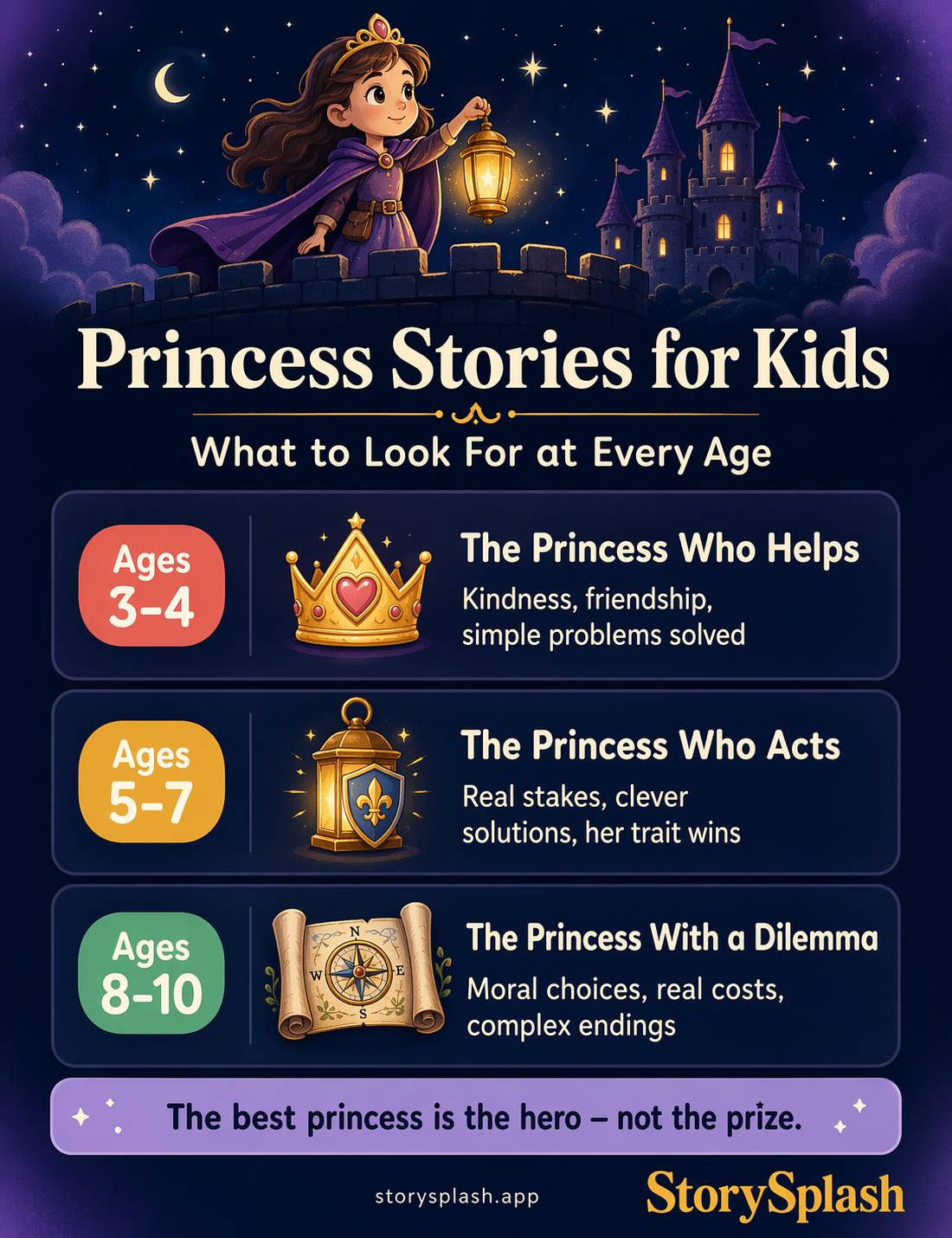
Ages 3–4: The Princess Who Helps
At three and four, children are working out how the social world operates. The most effective princess stories at this age centre on kindness, friendship, and simple problem-solving. The princess isn’t passive, she’s actively helping, sharing, or fixing something, but the challenges are proportionate to what a young child can follow.
Key characteristics to look for at this age:
- One clear problem with a clear resolution
- A princess who takes at least one meaningful action
- A friend or ally who helps (cooperation is a core 3–4 theme)
- No genuine peril — challenges that cause worry but resolve easily
- Simple, vivid language and ideally illustrations
Good story starting points: The Princess and the Pea in simplified form (curiosity and persistence), early Disney Princess short stories, and any princess story where the primary action is befriending someone who seemed scary or unfamiliar.
Avoid at this age: Stories with extended separation from parents, genuine villains who are frightening rather than bumbling, or romantic endings that the child has no framework for.
Ages 5–6: The Princess Who Acts
At five and six, children are ready for a princess who faces a genuine challenge and has to figure out how to handle it. The story can have real stakes, the kingdom is in danger, a friend is in trouble, something important has been lost, and the princess should be the primary solver, not the recipient of someone else’s solution.
This is a particularly important age to be intentional about princess stories, because five and six is when children are most intensely sorting the world into categories (“girls do this, boys do that”) and stories are a significant input into those categories. A girl who hears, at five and six, only stories where the princess is rescued, will have a narrower model than a girl who also hears stories where the princess does the rescuing.
Key characteristics to look for at this age:
- A princess who has a specific ability or personality trait that matters to the plot
- A genuine obstacle that requires cleverness or courage to overcome
- At least one moment where the princess could give up but doesn’t
- An ending where the princess’s success is explicitly linked to something she did or decided
Good story choices: Gail Carson Levine’s Ella Enchanted (too long for bedtime, but excellent as a chapter book), The Princess Knight by Cornelia Funke, Shannon and Dean Hale’s The Princess in Black series (adventure, slightly silly, exactly right for 5–7), Princess Smartypants by Babette Cole (a princess who actively doesn’t want to be rescued, played for comedy).
Ages 7–9: The Princess With a Real Dilemma
From seven, children can follow a story where the right thing to do isn’t obvious. The princess can face a genuine moral conflict: duty versus desire, loyalty versus justice, kindness to one person that requires cruelty to another. These are the most interesting princess stories, and children at this age often want to argue about them afterwards.
At this age, chapter books become appropriate bedtime material — read a chapter a night over two weeks rather than trying to fit a complete story into twenty minutes. This format also teaches children that stories can sustain over time, that you can carry a character with you across multiple nights, and that resolution sometimes takes work to earn.
Good story choices: Robin McKinley’s Beauty (a literary retelling of Beauty and the Beast, age 9+), Diana Wynne Jones’s Castle in the Air (a clever sequel to Howl’s Moving Castle, featuring a princess who is entirely unexpected), Tamora Pierce’s Alanna series (technically a knight, but the same energy, a girl in a traditionally male role proving herself on her own terms).
Discussion questions worth asking after a story at this age:
- “What would you have done differently?”
- “Was the princess right to choose [her decision]? What did she have to give up?”
- “Do you think the ending was fair? Why or why not?”
The quality of discussion a story generates is a good measure of how much it’s working.
Ages 9 and Beyond: The Princess as Literary Figure
From nine, children can read princess stories as literature — examining what the story is saying about power, gender, and society. A nine-year-old who reads Cinderella and then reads Angela Carter’s The Bloody Chamber is reading two completely different things that are both, technically, princess stories. That range is part of what makes the genre interesting.
At this age, access to strong young adult fantasy with princess protagonists opens up: Naomi Novik’s Uprooted (age 13+), Leigh Bardugo’s Shadow and Bone (age 12+), Roshani Chokshi’s The Star-Touched Queen (age 12+). These are not bedtime stories; they’re books. But the pathway from the princess story told at bedtime at five to these novels at twelve is a direct one.
Princess Story Themes That Go Beyond “Rescued”
The most versatile and enduring princess story themes involve the princess as an active force. Here’s a menu of themes that consistently land well and produce the kind of engagement that carries children past the story and into their own imagination.
The Princess Who Goes on a Quest. She has to find something, rescue someone, or fix something that’s broken. The quest structure is universal and works at every age, the challenge is scaling the obstacles and stakes appropriately.
The Princess Who Doesn’t Fit In. She’s different from what a princess is supposed to be — too noisy, too curious, too interested in dragons, and the story is about why different is good, actually. This theme resonates particularly strongly with children who feel like they’re failing to meet someone else’s expectations.
The Princess Who Makes a Mistake. She does something wrong — makes a hasty decision, hurts a friend, breaks a promise, and has to figure out how to make it right. Stories about earning forgiveness are rare but extremely valuable.
The Princess Who Befriends the Villain. The supposedly dangerous character (a dragon, a sea witch, an enemy prince) turns out to have reasons for their behaviour, and the princess is the one who looks closely enough to find them. This teaches children to look past surface intimidation to what’s underneath, one of the most socially useful skills available.
The Princess Who Gives Up the Crown. She has a choice between the position and everything that comes with it, and something she values more — friendship, freedom, a person she loves. The decision doesn’t have to go one way; what matters is that she makes it deliberately and understands the cost.
The Princess Who Uses What She Knows. Her specific knowledge — about plants, about animals, about magic, about people — is what solves the problem. The story values intellectual capacity as much as physical bravery, which is important for children who are more drawn to thinking than fighting.
What Makes a Princess Story Fall Flat
Some princess stories are genuinely bad, and it’s worth knowing why, so you can recognise them on sight.
The princess as passive object. She has no meaningful action in the story. Things happen to her. She is rescued, transformed, selected. Her value is entirely in her appearance or her lineage. She expresses preferences at most. This is the pattern worth being alert to, not because it’s evil, but because it’s boring, and because children who hear only this pattern have a narrower model of what a girl can be in a story.
The princess whose only goal is romance. The entire engine of the story is “will the princess marry the right person.” This is a complete narrative structure at 25; at 5, it’s strange and limiting. Young children don’t have the framework to make this interesting, and the stories that are primarily about this tend to be the thinnest ones.
The princess who is punished for ambition. She wants something, an adventure, a skill, an escape from constraint, and the story punishes her for wanting it. She’s humbled, corrected, or rescued back into the life she was trying to leave. This is a subtle one. It masquerades as a morality tale and is usually anything but.
The princess whose personality is entirely defined by her love for another character. She has no inner life that isn’t in relation to someone else. This isn’t a princess problem specifically, it’s a general problem in poorly constructed stories, but it tends to cluster in the romance-adjacent end of the princess genre.
None of these story types are forbidden. But they’re worth noticing, and the response to noticing them is a conversation: “What do you think about how [character] handled that?” “If you were her, would you have done the same thing?” That conversation is often more valuable than the story that prompted it.
Talking About Princess Stories With Your Child
These conversations don’t have to be formal and they don’t have to be critical. The goal isn’t to deconstruct every princess story your five-year-old enjoys. The goal is to keep the channel of engagement open, so that stories stay a thing you think about together rather than a thing that happens to your child passively.
Simple questions that open things up without leading the witness:
- “What would you do if you were the princess?”
- “What do you think she was most good at?”
- “If you could change one thing about how the story ended, what would it be?”
- “Would you want to be friends with her? Why?”
The answers will tell you more about how the story is landing, and what your child is taking from it — than any amount of preview research about the story’s content.
Building a Princess Character Your Child Identifies With
The most powerful thing you can do with princess stories is make them genuinely personal. This doesn’t require a particular app or resource, it requires a few minutes of attention.
The basic structure is simple:
- Give the princess your child’s name
- Give her one personality trait your child is actually proud of in themselves
- Put her in a world your child finds interesting
- Give her a problem that relates to something your child is currently navigating
A child who is struggling with a difficult friendship is given a princess who has to choose between two friends with competing claims on her loyalty. A child who is nervous about starting a new activity is given a princess entering an unfamiliar kingdom and earning her place. A child who has been told they’re “too much” is given a princess whose intensity turns out to be the exact quality that saves the day.
The fairy tale structure holds the story up. The personalisation makes it matter.
For personalised princess stories you don’t have to construct from scratch on a Wednesday night, StorySplash generates illustrated stories where your child is genuinely the protagonist, not just by name, but by character and world choice. The personalisation is real rather than template-deep. Many children ask for “the princess story with me in it” as their preferred bedtime format once they’ve tried it.
The Role of Dress-Up and Play in Princess Narratives
It would be incomplete to talk about princess stories without addressing the broader princess culture that surrounds them: the dresses, the role-play, the plastic tiaras, the birthday party themes. Parents who are thoughtful about princess narratives sometimes feel conflicted about this dimension in ways that are worth examining.
The dress-up play that accompanies princess stories is not simply passive absorption of the story’s messages. Children, especially between ages 3 and 7, use dress-up and role-play to process narratives, to try them on, to test them, to rewrite them from the inside. A child who puts on a princess dress and then announces that her princess is going to fight the dragon is not missing the point of the dress-up. She’s doing exactly what dress-up is for: inhabiting a role and then directing it herself.
This means the content of the play is more informative than the costume. A child who plays princess stories where she always waits to be saved might benefit from richer princess narratives in her story diet. A child who plays princess stories where she builds armies, negotiates treaties, solves magical puzzles, and befriends the dragon is demonstrating that she’s integrating a much more active model, even if she’s wearing exactly the same pink dress.
Watch what your child does in the play, not just what they’re wearing. The costume is the frame; the agency is the picture.
Building a Princess Storytelling Practice With Your Child
Some of the most effective princess story experiences happen not when a parent reads a story but when the parent and child build one together. This is within reach for most parents, even those who don’t consider themselves storytellers.
The structure is simple:
Start with a question: “What kind of princess are we telling a story about tonight?” Let the child answer. They’ll tell you the trait they most want to embody or explore: brave, clever, kind, stubborn, magical, funny. This is the hero’s core characteristic.
Establish the world: “And where does this princess live?” Let the child choose: castle, forest, underwater palace, space station, talking-animal kingdom. Whatever they choose, commit to it. The more specific the world, the better.
Introduce a problem: Something is wrong in the kingdom, or something the princess needs. Keep it proportionate to the child’s age, a lost treasure for a 4-year-old, a kingdom in conflict for an 8-year-old.
Ask the child what the princess does: At every decision point, pause. “What do you think she does now?” The child’s answer shapes the story. You’re not performing for them; you’re building with them.
Resolve it using the core trait: The brave princess finds her bravery is exactly what was needed. The clever princess’s specific knowledge solves the problem. The resolution uses what the child told you at the start, which teaches them that the trait they chose is genuinely valuable.
This practice builds creative confidence, narrative intelligence, and a deeply personal relationship with the princess story form. It also tends to produce the stories children remember longest, not the polished picture books, but the imperfect, improvised adventures that happened specifically for them.
Why Princess Stories Are Good for Boys Too
The category “princess stories” is culturally gendered in a way that does boys a disservice. The best princess stories are about navigating power, fulfilling responsibility, making meaningful decisions, managing other people’s expectations, and acting with integrity when it’s difficult. These are not female themes. They’re human themes.
Boys who are given access to a wide range of story protagonists, including female ones — develop broader social empathy and a more flexible model of what a hero can be. A boy who only reads stories about male heroes knows that boys can be brave, clever, and determined. A boy who also reads stories about princess protagonists knows that girls can be brave, clever, and determined too, which makes him better equipped to actually experience the world he’s going to live in.
The practical application: if your son asks for a princess story, tell it with the same enthusiasm you’d bring to any other request. If he never asks, it’s worth occasionally offering one without fanfare — “I read a great story today about a princess who did something really clever, want to hear it?”, not as a lesson, but as an expansion of the repertoire.
How Princess Stories Handle Villains
The villain in a princess story is often the most interesting character, and how the story handles that villain says a lot about what it’s really teaching.
The classic princess story villain, the evil stepmother, the wicked witch — tends to be evil because she is. There’s no explanation, no backstory, no moment of empathy. She is simply the obstacle. This is age-appropriate for young children who are still building their model of cause and effect; the cleanness of pure villainy is easier to process than moral complexity.
But as children grow, the most valuable princess stories are the ones where the villain is more complicated. The queen who seems cruel turns out to be protecting something. The dragon who seems terrifying is lonely. The witch who casts the spell had her own loss that preceded the cruelty. These complications don’t excuse the villain’s actions, but they make the story more interesting, and more true.
A princess protagonist who can see the complexity in an apparently villainous character, and who responds to that complexity with curiosity rather than simple opposition — is modelling exactly the kind of social intelligence children need. This is one of the reasons the “princess befriends the villain” story type is worth seeking out, particularly for children from about age 6.
What Princess Stories Teach About Power
One of the most underappreciated dimensions of the princess story is what it teaches about power: what it is, how it works, and what it costs.
A princess has power. More precisely, a princess occupies a position that is loaded with social expectation, obligation, and constraint. The interesting question in any princess story is what the protagonist does with that position. Does she use it thoughtfully? Does she abuse it? Does she chafe against it? Does she discover that the power she assumed she had is less than she thought, or more?
For young children, these questions operate below the surface. The child isn’t consciously analysing the power dynamics of the story; they’re simply experiencing a character navigating a world with rules and stakes. But the patterns they absorb matter. A princess who uses her position to help others teaches something different from a princess who uses it primarily to secure her own happiness. A princess who challenges unjust rules teaches something different from one who complies.
The best princess stories use the power question deliberately. They put the protagonist in situations where her position gives her options and obligations simultaneously, and the story is about how she navigates that tension. This is excellent preparation for the real-world experience of having responsibility for other people, which all children will eventually face.
For parents thinking about which princess stories to prioritise, this lens is more useful than any checklist. Ask: what does this story teach about what it means to have power over others, and to be responsible for using it well?
The Broader Picture: Princess Stories in a Varied Reading Diet
Princess stories should be part of a varied diet, not the whole of it. A child who reads only princess stories is in a similar position to a child who eats only one food — technically nourished by that one thing, but missing the range that makes for genuine intellectual health.
The goal is for your child to move fluidly between different story types: princess stories, adventure stories, dragon stories, fairy tales, funny bedtime stories, moral stories, and stories that don’t fit neatly into any category. Each of these does something slightly different for a child’s imagination and emotional vocabulary.
The best use of princess stories is as one thread in a rich ongoing narrative life, a thread that, at its best, shows children what power and responsibility look like in someone who looks like them.
That’s worth preserving. It’s also worth being thoughtful about. Both things are true at once.