Ask any group of children what kind of story they want tonight and “adventure” will be the most common answer. It is also one of the most overused words in children’s publishing — not every adventure story lands at bedtime, and the ones that don’t leave a child more wound up than when you started.
Here is what actually makes an adventure story work at night, plus an age-by-age breakdown.
What Makes an Adventure Story Work at Bedtime
The challenge with adventure is that it can go in two directions: exciting-and-escalating, or satisfying-and-resolved. Bedtime needs the second kind.
A good adventure story for bedtime builds tension, gives the hero something real to solve, and then resolves cleanly. The child knows the hero made it. The world is safe. That sense of resolution is what lets the mind rest — contrast this with cliffhangers, which do exactly the opposite. A story that ends on a question keeps the brain working. A story that ends with the hero home and safe gives the brain permission to stop.
Practical tip: Before bedtime, check whether the story ends with resolution or a teaser. Cliffhangers are great for daytime reading. At night, you want a story that closes.
Age-by-Age Guide to Adventure Stories
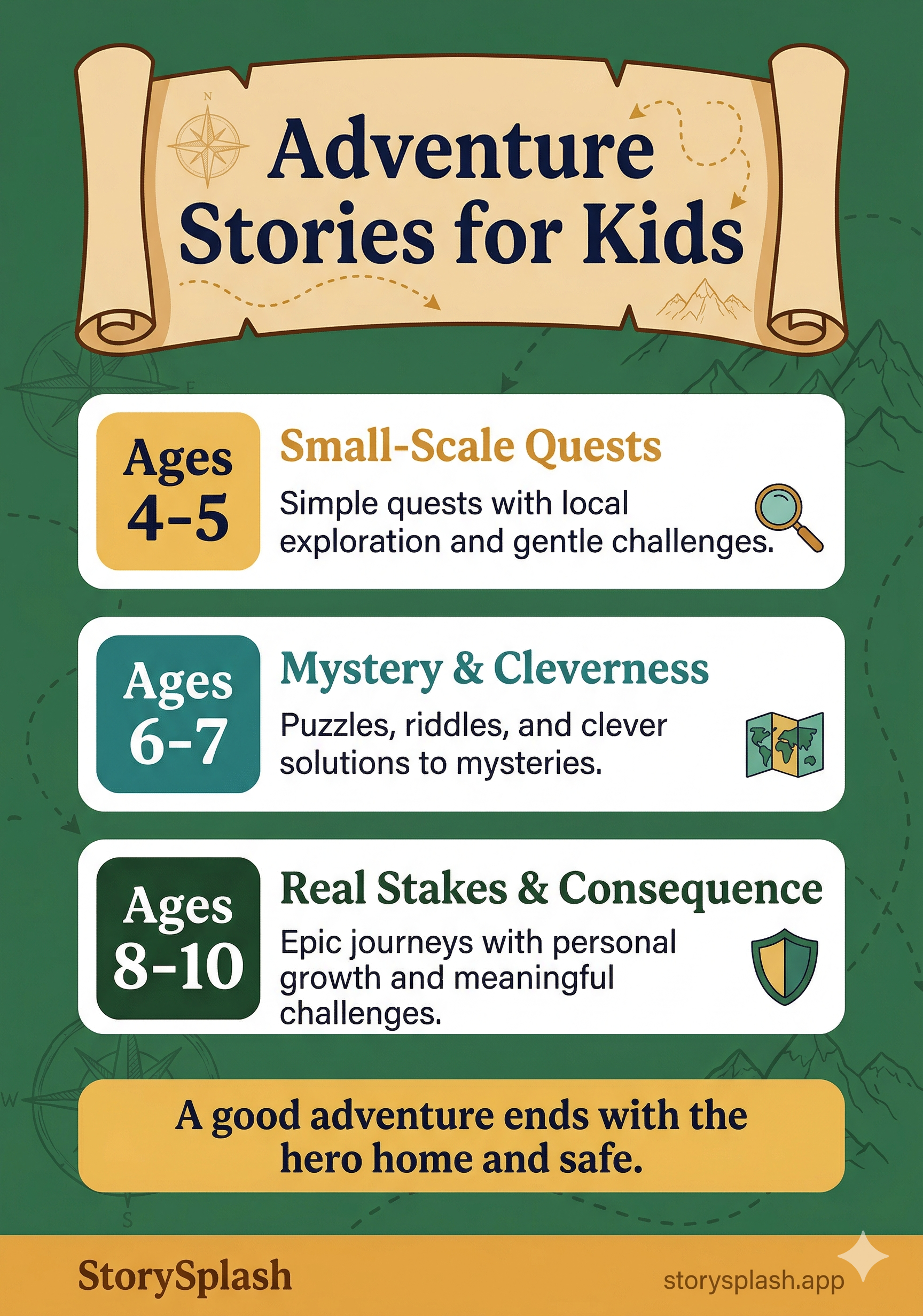
Ages 4–5: Adventures need to be small-scale and emotionally grounded. A child who goes on a quest to find a lost toy, rescue a friendly animal, or explore a magical garden is the right scope. The challenge should feel big to the child-sized hero, but the stakes should be reassuring rather than threatening. Simple problems, clear solutions, happy endings.
Ages 6–7: Scale up the challenge without raising the stakes to threat level. A map to follow, a mystery to solve, an obstacle that requires cleverness rather than force. Children this age want to feel smart, not just brave. A hero who outthinks the problem resonates more strongly than one who simply fights through.
Ages 8–10: True adventure with real stakes. The hero might fail the first attempt. There may be more than one obstacle. Allies matter, decisions have consequences, and the resolution is earned. At this age, the adventure can carry a theme — loyalty, courage, what it means to do the right thing when it costs something.
Practical tip: At every age, end the adventure with the hero resting. The final image of a story — hero home, safe, asleep under the stars — mirrors what you want your child to do next.
Setting Matters as Much as Plot
Adventure stories benefit enormously from a specific world. A generic forest is less engaging than a forest where the trees whisper directions to lost travellers. A generic ocean becomes the story when it is an ocean where the currents run backwards and sea creatures speak in riddles.
The more specific the world, the more invested your child becomes in what happens there. This is especially true when your child is the hero — a vivid setting makes the adventure feel real, which makes engagement deeper and the memory of it stronger the next morning.
Practical tip: Give the world one unusual rule before the story starts. “In this world, animals can talk but only in questions.” That single detail makes the setting memorable and gives the story a consistent logic.
The Difference Between a Hero and a Spectator
The best adventure stories for children cast the child as the active decision-maker — the one who chooses, plans, takes risks, and earns the outcome. Not a spectator watching an adult solve everything. Not a passenger carried through events.
When the hero shares your child’s name and faces choices your child would recognize as their own, engagement shifts. They start caring about the outcome in a way they do not care about a stranger’s story. They lean in. They stop asking when it will be over. That investment is what makes bedtime feel less like a battle and more like the part of the day they were waiting for.
Don’t have time to tell this story tonight? StorySplash generates it for you in 30 seconds.