There’s a reason the same basic stories keep appearing across cultures separated by thousands of miles and hundreds of years. A girl outwitting a dangerous stranger in the woods. A young man who succeeds through kindness where his proud brothers fail. A sleeping figure waiting to be found. These aren’t just stories. They’re structures that do something for children that straightforward narrative can’t.
This guide is for parents who want to use fairy tales well, not just as a way to fill the twenty minutes before lights out, but as a genuine tool for building imagination, processing the harder edges of childhood, and creating the kind of bedtime ritual that children remember into adulthood.
Why Fairy Tales Have Lasted Three Hundred Years
The versions of fairy tales that most parents know — Cinderella, Snow White, Little Red Riding Hood, Jack and the Beanstalk — came primarily from the written collections of Charles Perrault in the late 1600s and the Brothers Grimm in the early 1800s. But the stories themselves are far older. Cinderella-type tales appear in ancient Egypt. Sleeping Beauty variants predate written records. These weren’t invented by a committee. They survived because they work.
The psychologist Bruno Bettelheim spent a career studying why, and his conclusion — published in The Uses of Enchantment in 1976 — was essentially that fairy tales speak to the unconscious. They give children a way to work through the major anxieties of childhood (abandonment, powerlessness, the fear of dangerous adults) through symbolic action rather than direct confrontation.
A child who hears Little Red Riding Hood isn’t being taught that wolves talk. They’re rehearsing for the moment they meet someone whose friendliness doesn’t feel quite right, and learning that noticing that instinct, and listening to it, matters. The story works below the surface, at a level where simple instruction can’t reach.
That symbolic function is what makes fairy tales so durable. They’re not just entertaining; they’re doing quiet work that children need done.
What Fairy Tales Actually Do for Children
Understanding what a fairy tale is for changes how you choose and tell them. Here are the core functions, mapped to what parents actually see at home.
They make fear manageable. Fairy tales are deliberately frightening in measured doses. The wolf is real. The witch is genuinely dangerous. The forest is dark. But the story always comes out the other side, and the child who was terrified at page twelve is triumphant at page thirty. This arc teaches children experientially, not theoretically, that fear is survivable. That lesson is more powerful than any reassurance a parent can give.
They establish a moral grammar. The rules of a fairy tale world are consistent and intuitive. Kindness is rewarded. Greed is punished. The clever girl beats the powerful prince. The youngest son, overlooked and underestimated, is the one who earns the kingdom. Children absorb these patterns and begin to build an internal sense of how moral cause and effect works — long before they’re able to articulate it.
They develop narrative intelligence. Following a fairy tale requires tracking multiple characters, understanding motivation, predicting consequences, and holding the whole arc in mind. This is cognitively demanding work, disguised as entertainment. Children who grow up in homes where stories are told and retold tend to develop stronger reading comprehension and more sophisticated social reasoning — in part because they’ve been practising narrative tracking since they were three.
They give language to big emotions. When a child says they feel like they’re in a dark forest, or like the witch is watching them, they’re using the story’s vocabulary to name an internal experience. This is enormously valuable. Children often can’t access abstract emotional vocabulary directly, but they can point to a story that captures what they feel. That access is a building block for emotional articulation.
They create shared cultural vocabulary. Fairy tales are one of the few genuinely shared imaginative spaces that cross generations, languages, and cultures. A child who knows Cinderella can connect to grandparents, books, films, and a thousand references they’ll encounter throughout their life. This shared vocabulary matters more in a fragmented media landscape, not less.
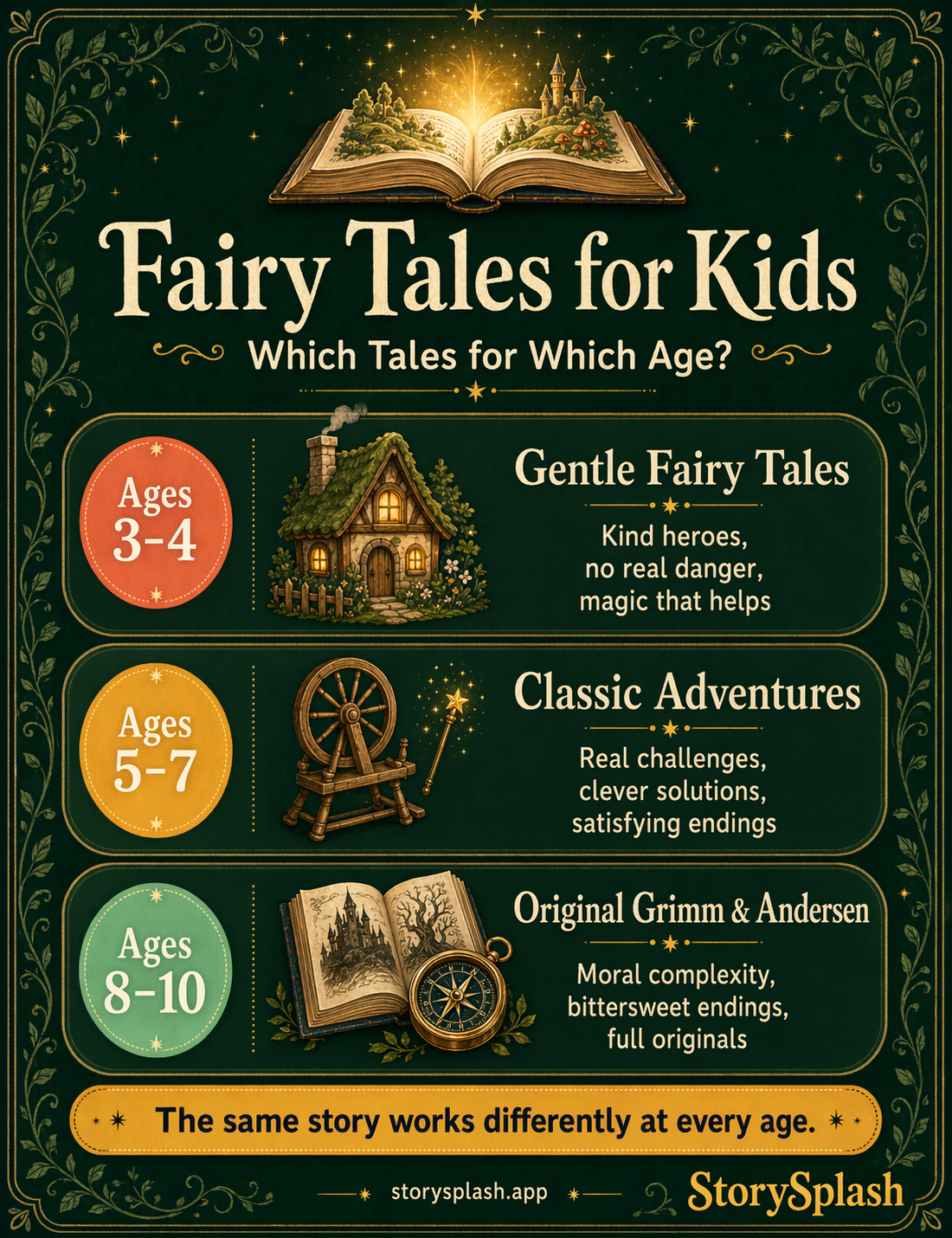
An Age-by-Age Guide to Fairy Tales
Not all fairy tales are right for all ages. Here’s how to match story to child.
Ages 3–4: The World Is Friendly and Magic Is Kind
At three and four, children are just beginning to construct a model of the world outside their immediate family. The fairy tales that work best at this age confirm that the world can be navigated and that good things happen to kind, curious children.
The core characteristics of a good 3–4 fairy tale:
- Simple structure (no more than 2–3 main characters)
- Clear emotional beats, the hero feels one thing at a time
- A villain who is bumbling rather than genuinely terrifying
- Resolution that depends on kindness, cleverness, or friendship
- No death (or implied death that isn’t followed by a clear magical reversal)
Good choices: early versions of The Three Bears (conflict is resolved by leaving), The Elves and the Shoemaker (magical helpers, benign resolution), The Enormous Turnip (cooperative effort wins), simple Thumbelina tales.
Avoid at this age: the original Little Red Riding Hood (grandmother’s fate is ambiguous at best), Hansel and Gretel in full (abandonment, murder), Bluebeard (not for any age of young child).
Ages 5–6: The Hero Faces a Real Challenge
At five and six, children are ready for stories with genuine stakes. The hero should face something they might actually fail at. The villain can be properly scary. The challenge can require the hero to be not just kind but actively clever, brave, or persistent.
The core characteristics of a good 5–6 fairy tale:
- A clear challenge that the hero must solve, not just survive
- A villain with genuine menace (not just silliness)
- Multiple story beats — complication, failed attempt, second attempt, resolution
- Resolution that depends on something the child can identify with: bravery, cleverness, kindness paid forward
- Emotional complexity, the hero can feel scared but still act
Good choices: Jack and the Beanstalk (bravery despite fear, mother-approved theft framing), Cinderella in a modern retelling (injustice noticed and reversed), Beauty and the Beast in simplified form (looking past surface appearance), Puss in Boots (clever problem-solving).
At this age, children also benefit from fairy tales where the hero is a girl who solves her own problems, not because gender-swapping is mandatory, but because a wider repertoire of hero archetypes gives children more to identify with. If your child has only ever heard stories where the girl waits and the boy acts, that’s a narrow model.
Ages 7–9: Moral Complexity Becomes Interesting
From seven onwards, children can hold moral ambiguity. The hero can make a mistake and have to fix it. The villain can have a reason for being cruel, even if the cruelty is still wrong. The resolution doesn’t have to be perfectly fair, sometimes the good character suffers; sometimes the lesson is hard.
The core characteristics of a good 7–9 fairy tale:
- Multi-beat plots with genuine obstacles and reversals
- Characters who have competing interests, none of which are simply evil
- Consequences that feel earned rather than arbitrary
- Space for the child to disagree with the resolution and discuss it
- Original-language versions becoming appropriate (Grimm’s original tales, Andersen’s complete works)
Good choices: The Little Mermaid in its original form (a genuinely sad ending that can prompt real discussion), The Snow Queen (heroism through patient love rather than strength), East of the Sun and West of the Moon (a quest driven by genuine regret and persistence), original Cinderella with the full stepsisters’ punishment scene.
At this age, a conversation after the story is often more valuable than the story alone. “Why do you think she made that choice?” “Was that fair?” “What would you have done?” These questions deepen the impact without requiring a lecture.
Ages 9 and Beyond: Fairy Tales as Literature
From nine, children can engage with fairy tales as a literary form — examining why the same story appears in a hundred cultures, what the wolf actually represents, why the youngest son always wins. At this age, collections like Angela Carter’s The Bloody Chamber (for teenagers) or Marina Warner’s criticism become interesting context.
More immediately, this is the age to give children access to the Hans Christian Andersen originals in full, the Grimm stories without the softening, and retellings that play with the form — Robin McKinley’s Beauty, Gail Carson Levine’s Ella Enchanted, or Neil Gaiman’s fairy tale riffs.
The Major Classic Fairy Tales: A Parent’s Reference
Here’s a quick guide to the fairy tales most parents will encounter and what each is actually doing.
Cinderella
Core lesson: Injustice noticed by the universe is eventually corrected. Goodness under adversity is not wasted.
The deeper function: Cinderella is one of the most popular stories in the world partly because it speaks directly to the child’s experience of powerlessness within the family. Most children have felt, at some point, that a sibling or another child was favoured. Cinderella says: that’s real, it’s unfair, and it won’t be the last word.
Age to introduce: Simplified versions from 4. Full original from 6.
Watch for: Some versions include the stepsisters’ eyes being pecked out by birds. Fine for 7+, worth skipping the detail for younger children.
Little Red Riding Hood
Core lesson: Strangers who are too friendly should be treated with caution. Your instincts matter.
The deeper function: This story teaches children to recognise the difference between genuine kindness and performed kindness. The wolf is performing care. The child who goes off the path is not stupid, she’s being actively deceived. The lesson isn’t “trust no one.” It’s “notice when something feels wrong.”
Age to introduce: 5–6 for most versions. The original Perrault ending (no rescue, the girl is eaten) is for 7+.
Jack and the Beanstalk
Core lesson: Bravery in the face of overwhelming power. Taking a risk that could fail.
The deeper function: Jack breaks every rule and wins. He trades the family’s last cow for magic beans, steals from the giant, and escapes by quick thinking. This breaks the usual moral pattern of fairy tales — virtue rewarded, and instead rewards a kind of reckless courage combined with practical cunning. Children love this story partly because it’s transgressive in a way that most approved stories aren’t.
Age to introduce: 4–5.
Sleeping Beauty
Core lesson: Some things have to wait; being found is not the same as being passive.
The deeper function: This story is more interesting than its passive reputation suggests. The princess isn’t simply waiting, she’s under an enchantment that can’t be broken by effort. The lesson, subtly, is that not everything can be solved by trying harder. Sometimes you wait, and the right moment comes. That’s a genuinely useful piece of wisdom for children who experience anxiety.
Age to introduce: 4–5 for simplified versions. Original Perrault (with its darker second half involving the prince’s ogress mother) is for 8+.
Hansel and Gretel
Core lesson: Children can solve adult-sized problems. Even the most frightening situations have a way out.
The deeper function: This story confronts one of childhood’s deepest fears directly: abandonment by parents, followed by capture by a predator. The resolution, the children save themselves through cleverness and cooperation — is one of the most empowering endings in the fairy tale canon. Two children, alone, defeat a murderous adult through their own intelligence.
Age to introduce: 6–7. The story requires a child who can hold the complexity of loving parents who do a terrible thing.
How Fairy Tales Have Changed: Modern Retellings
The fairy tales most children encounter today are significantly different from the originals, and mostly for the better. The changes reflect genuine improvements rather than squeamishness.
Modern retellings tend to:
- Give female characters more agency and intelligence
- Remove or contextualise racial and class-based assumptions in the originals
- Replace passive rescue with active problem-solving
- Add nuance to villain motivations
- End with solutions that the hero earned rather than received
The risk is over-sanitisation, stories where nothing bad happens, no genuine fear is introduced, and the resolution costs nothing. Children read these as hollow. They know, intuitively, that a story without stakes is a story with nothing to say.
The best modern fairy tale retellings keep the emotional truth of the original, the genuine fear, the genuine injustice, the genuine cost of bravery, while updating the framing. They’re not lesser versions of the originals. They’re often better ones.
If you want to explore modern retellings, some reliable starting points: the Grimm’s Fairy Tales adaptations from Usborne for ages 5–8, Roald Dahl’s Revolting Rhymes for ages 6–10 (deliberately funny subversions), and Shannon and Dean Hale’s The Princess in Black series for independent readers from 6.
What to Watch for in Older Versions
The Brothers Grimm were collecting folk tales, not writing for children. Their original texts contain:
- Death of major characters without magical reversal (the original Little Match Girl, the original Little Mermaid)
- Graphic violence against villains (the stepsisters’ feet cut off, eyes pecked out)
- Racial and ethnic stereotypes that haven’t aged well
- Sexual content in some lesser-known tales
None of this means the originals should be avoided, but they’re not appropriate for under-7s and benefit from context when read with older children. If you’re reading from a collection published before 1990, it’s worth previewing first.
How to Personalise a Fairy Tale Tonight
This is one of the most powerful things you can do as a parent, and it costs nothing.
The fairy tale structure, ordinary hero, extraordinary challenge, magical transformation, triumphant return — is infinitely adaptable. You keep the bones and change the flesh:
Swap the hero’s name. This is the most basic level, but it works. When the story is about your child going into the enchanted forest, the engagement is immediate and different.
Change the setting to one they love. Your child loves space? The enchanted forest becomes a moonlit asteroid belt. They love the ocean? The castle is underwater. The structure of the story works in any setting.
Make the challenge one they’re currently facing. A child working through starting at a new school? The hero enters a new kingdom where no one knows them, and has to earn their place. A child worried about a younger sibling getting more attention? The story is about the older sibling proving they’re still important. Fairy tales are extraordinarily elastic here.
Give them an ally who reflects their real strengths. The magical helper in a fairy tale (the fairy godmother, the helpful fox) can be a version of something your child is already good at, their curiosity becomes a companion creature who knows everything about the world; their stubbornness becomes a steady horse who never gives up.
This kind of on-the-fly personalisation takes practice, but children are forgiving collaborators. If you lose the thread, they’ll usually offer to help you find it.
If you’re not a natural improviser or just don’t have the creative energy at 8:30pm on a Tuesday, StorySplash generates this kind of personalised story in about two minutes, your child picks a theme and a world, and the story becomes properly theirs rather than a name-swapped template. The fairy tale structure stays intact; the personalisation is real.
The Oral Tradition and Why It Still Matters
Before Perrault or the Grimm brothers wrote anything down, fairy tales were told. Not read — told, from memory, reshaped in the telling, adapted to the audience in the room. The storyteller looked at the faces of the children and felt when to linger, when to rush, when to lower their voice to a whisper and when to pause for effect.
This oral dimension isn’t incidental to what fairy tales are. It’s their original form, and the things that made oral storytelling powerful haven’t changed just because most of us deliver stories from a page rather than from memory.
Several principles carry over directly into how you tell a fairy tale at bedtime:
The voice is the instrument. How you pace a story, when you pause, how quietly you read the final pages, these decisions shape the child’s experience as much as the words do. A fairy tale read at a flat, even pace across all thirty pages loses the peaks and valleys that make it memorable. Slow down before the confrontation. Quieten into the resolution. The child’s nervous system will follow your lead.
Repetition is structural, not lazy. Classic fairy tales repeat: three brothers attempt the task; three nights pass; the phrase is said three times. This repetition is not a failure of imagination; it’s a feature. Young children love repetition because it creates anticipation, they know what’s coming, and they lean in to see if they’re right. Don’t abbreviate the repetitions out of the story.
Reaction is part of the story. In oral storytelling, the audience’s reaction is visible and the teller responds to it. When you read to a child, their reaction is available too, the held breath, the asking “what happens next?”, the pulling up of blankets as the tension rises. These responses are invitations to slow down and deepen, not to rush past.
The ending lands differently when it’s delivered deliberately. The final line of a fairy tale should be the quietest line in the story. Whatever the content, the delivery should signal: this is the end, this is rest, this is safe. The child’s nervous system registers that signal and responds accordingly.
How Illustrations Shape the Fairy Tale Experience
The illustrations in a fairy tale are not decoration. For young children especially, who are still developing the ability to sustain mental imagery purely from language, illustrations are doing half the imaginative work.
The best fairy tale illustration traditions — Arthur Rackham’s dense, atmospheric ink drawings, Kay Nielsen’s painterly Nordic compositions, the Dulac illustrations that shaped how a generation imagined Scheherazade — create a visual world so specific and consistent that the story’s characters feel as real as anyone the child has met.
When choosing illustrated editions of fairy tales for young children, a few things are worth considering:
Visual consistency matters. The characters should look the same across all illustrations. Inconsistency, a different version of the hero on page 12 than on page 3 — breaks immersion for children who are using the illustrations to build their mental model.
Age-appropriate visual register. The illustration style that works for a three-year-old (soft, rounded, brightly coloured, expressively simple) is different from what works for an eight-year-old (more detailed, more atmospheric, capable of genuine shadow and menace). The Usborne Illustrated Fairy Tales series is aimed well at the 5–8 range. Arthur Rackham’s originals are better appreciated by 9 and up.
The final illustration matters as much as any other. The last image in a fairy tale, the wedding, the homecoming, the hero at rest — is what the child carries into sleep. An illustration that captures that moment with warmth and finality is doing specific work. An illustration that ends on an action beat (the hero still mid-fight) leaves the child with a less settled final image.
For parents using AI-generated stories, consistent illustration is one of the most important quality markers. A generated story where the main character looks different on every page loses the visual continuity that gives a story its sense of a real, persistent world.
Reading Versus Telling Versus Generating
There are three ways to deliver a fairy tale, and each has advantages.
Reading from a book is the most traditional and has real benefits. The child connects the story to a physical object, they can hold it, return to it, develop a relationship with a specific edition. The consistent text means the story is exactly the same each time, which very young children often prefer. The illustrations in a good picture book edition contribute significantly to the experience.
Telling from memory (or improvising) creates a different kind of intimacy. The story is made for this child, tonight, in real time. There’s no book between you. The eye contact is different. The pace can adjust to the child’s responses. For many children, the stories a parent told them from scratch are the ones they remember most vividly as adults, not because they were technically better, but because the experience of being told a story directly is irreplaceable.
Using a story app or generator solves the problem that not every parent has the time or creative energy to improvise a full story every night. The best apps, like StorySplash — don’t replace the parent in the room, but they do provide a quality story on demand, illustrated, personalised, and complete. The parent is still present; they’re not performing.
There’s no hierarchy here. Different nights call for different approaches. A beautiful edition of Grimm’s tales on a Sunday afternoon. A quickly improvised dragon story on a hectic Wednesday. A generated, illustrated adventure on Friday when everyone is exhausted. The goal is a story that works, not adherence to a method.
Making Fairy Tales a Consistent Ritual
The research on bedtime routines consistently points in the same direction: the predictability of the routine matters as much as its content. A child who knows that a story comes after bath, after teeth, after getting into bed, and that the story will always happen, even when it’s a short one — settles more easily than a child whose bedtime varies each night.
Fairy tales are particularly well-suited to this routine because they have an established structure that children internalise quickly. The hero goes out, faces a challenge, and comes back changed. Once your child knows this pattern, hearing it again each night is reassuring rather than boring, like the beat of a familiar song.
Some families find it useful to establish a “series”, the same hero having a different adventure each night in the same world. This is exactly how oral fairy tale traditions actually worked: wandering characters who appeared in different stories, recognised and welcomed by the audience each time. If your child has a particular protagonist they love, there’s no reason the same character can’t have a new adventure every bedtime for months.
For more on how to build the broader structure around the story, our guide to bedtime routine charts for kids walks through the full sequence that makes story time land most effectively.
A Note on Fear and What to Do With It
Some children are frightened by fairy tales. This is normal, and the response matters.
The wrong response is to remove all frightening stories. This deprives children of the rehearsal that makes fear manageable, and signals that fear is too dangerous to be examined.
The right response is to stay present with the fear. Read the story anyway, at whatever pace the child needs. Pause when they’re scared and say “I know, it’s scary. What do you think happens next?” Let them participate in navigating it. Then get to the resolution. Then, after the story, come back to it: “Were you scared when the wolf appeared? Me too. But then what happened?”
Children who regularly encounter managed fear in stories tend to develop better emotional regulation in real situations. The fear in the story is real fear, and the child who faces it and comes through is genuinely braver at the end than they were at the beginning. That’s not a metaphor. That’s what the research shows.
If a specific story is consistently causing nightmares or distress beyond what passes within a day or two, set it aside for a few months. But don’t conclude from that that fairy tales themselves are a problem. Find a different story, one whose fear level is a closer match for where your child is right now. Come back to the harder one later.
The Stories Worth Returning To
The fairy tales that have lasted are the ones worth knowing well. Not as a cultural box-ticking exercise, but because they contain genuine emotional intelligence about the human experience, compressed into a form that children can access.
A child who knows Cinderella has a framework for experiencing injustice. A child who knows Jack and the Beanstalk has a model for taking calculated risks. A child who knows Hansel and Gretel knows, somewhere below articulation, that even the worst situation can be navigated by a clever child who doesn’t give up.
That’s not a small thing to carry into adult life. And it starts at bedtime, with a story, at ages three or four, or whenever the right story finds them.
For a wider look at the story themes that consistently resonate with children this age, see our guides to dragon stories for kids and adventure stories for kids, which share some of the same structural DNA as the fairy tale tradition.