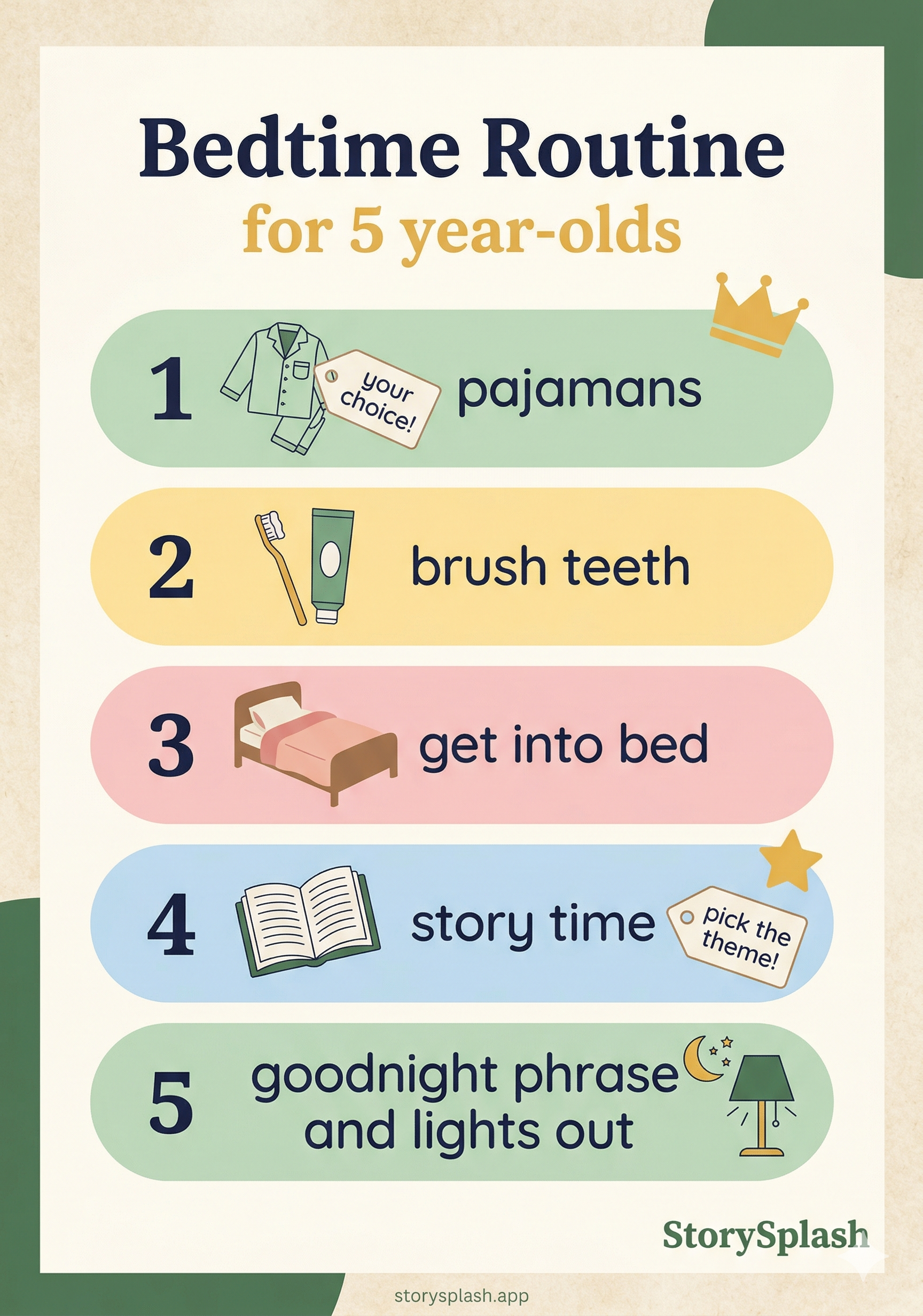
Five is a tricky age for bedtime. Your child is old enough to understand what’s happening, which means they’re also old enough to negotiate, delay, and find creative reasons why sleep can wait.
The good news: that same developmental awareness means a consistent routine finally sticks at this age. Here’s how to make it work.
There’s a free printable version below if you want to use it as-is.
Why 5-Year-Olds Push Back at Bedtime
Resistance at bedtime from a 5-year-old usually isn’t about sleep. It’s about autonomy. Five-year-olds are in the middle of a significant push for independence — they want to choose, decide, and feel in control of what happens to them.
The mistake most parents make is trying to win this argument every night. A better approach is to build autonomy into the routine rather than against it. Give your child two small choices within the fixed sequence: which pajamas, which one story to hear tonight. The sequence stays the same; the choices within it give them the agency they’re looking for.
This reduces resistance without reducing structure. Your child doesn’t feel steamrolled. You don’t spend twenty minutes negotiating.
Practical tip: Offer choices that are both acceptable to you. “Do you want the space story or the dragon story tonight?” is a better offer than “what do you want to do before bed?” — the first keeps the routine intact; the second invites chaos.
A 20-Minute Bedtime Routine That Holds for 5-Year-Olds
The sequence matters more than the duration. Keep it predictable enough that your child’s nervous system starts the wind-down before you even start.
| Step | What to do | Target time |
|---|---|---|
| 1 | Pajamas (child’s choice) | 2 minutes |
| 2 | Brush teeth and use the bathroom | 5 minutes |
| 3 | Get into bed | 1 minute |
| 4 | One story (child picks the theme) | 8 minutes |
| 5 | Goodnight phrase, lights out | 4 minutes |
The key is the same phrase to end the routine every night. “Sleep tight, brave one” or whatever feels natural to you. The phrase becomes a sleep cue over time — by the second week, your child will be half-asleep before you finish saying it.
Practical tip: Do the routine in the same order every night, even on weekends. Consistency is the entire mechanism. The routine only works because repetition makes it automatic.
Make the Story the Moment They Look Forward To
At five, children are deeply invested in narrative. They want to know what happens next. They remember what happened last night. They start anticipating the story before they’ve even gotten into bed.
Use this. Make the story something your child genuinely looks forward to, not something you’re producing under pressure at the end of a long day. When a story features your child as the main character — exploring a world they chose, facing a challenge that resonates with them — the anticipation pulls them through the earlier steps without a fight.
If you’re short on inspiration at 8:30pm, StorySplash generates a personalized illustrated story starring your child in about two minutes. Pick the theme together at step 3, and by the time they’re settled in bed, the story is ready.
Practical tip: Let the story length do the work. A well-matched story for a 5-year-old runs 5-8 minutes. Any longer and you risk a second wind. Any shorter and the transition to sleep feels abrupt.
Handling the Nights When It Falls Apart
Travel, illness, late dinners, big social events — something will knock the routine off track. The instinct is to compensate: add extra books, stay longer, skip steps to save time. All of these break the routine in different directions.
The better move is a compressed version of the same sequence. Even pajamas, a very short story, and your goodnight phrase — three minutes total — signals to your child that bedtime is happening, even when the rest of the day was unusual. The signal is what matters, not the duration.
Build in one non-negotiable: the story stays in the routine even on hard nights. A short story is better than no story. Skipping it removes the most powerful sleep cue in the sequence.
Practical tip: Have a two-minute emergency story option ready. A simple, familiar story you can tell from memory. The fallback makes consistency possible when life gets in the way.