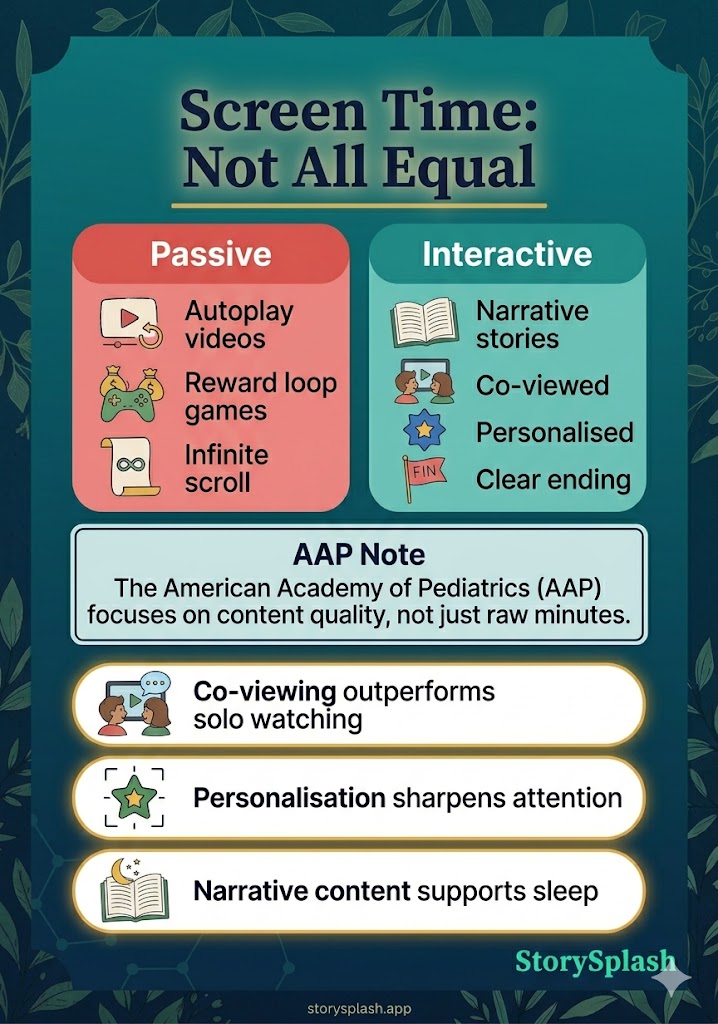
The phrase “screen time” has become a catch-all for parental anxiety, but it flattens a real distinction that matters. Thirty minutes of a child watching autoplay videos is not the same as thirty minutes of reading an illustrated story together on an iPad.
The research backs this up — and it changes how you should think about which apps earn a place in your family’s routine.
There’s a free printable guide below.
Passive vs. Interactive: The Distinction That Actually Matters
The American Academy of Pediatrics moved away from blanket screen time limits in 2016 for a reason. Their updated guidance focuses on quality and context rather than raw minutes. The key question isn’t “how long?” — it’s “what is my child doing, and are they doing it alone?”
Passive consumption — scrolling, autoplay videos, repetitive games with no narrative — offers very little developmental return. The child is a spectator.
Interactive or co-viewed content is different. When a child is engaged in the story, asking what happens next, identifying with a character, or reading alongside a parent, the brain is doing meaningful work: building vocabulary, processing narrative structure, developing empathy by inhabiting another perspective.
What Personalised Stories Do That Other Screens Don’t
Generic content, even high-quality generic content, requires a child to project themselves onto a character they have no connection with. That’s a cognitive step that takes effort — and for younger children especially, it’s effort that can break the engagement entirely.
When a child’s own name appears in the story, something neurologically different happens. Their attention sharpens. They lean in. The story stops being something they’re watching and starts being something that’s happening to them.
This is the mechanism behind why personalised bedtime stories tend to produce the reading-together moments parents remember: the child is genuinely absorbed, not just passively watching a screen.
The Co-Viewing Effect
The research on co-viewing is consistent: children who experience screen content alongside a parent show significantly better comprehension and vocabulary retention than those who consume the same content alone. The parent’s presence — their reactions, their questions, their pauses — transforms the experience.
A story app used at bedtime, with a parent reading aloud and a child following along, checks every box the research identifies for beneficial screen time. It’s interactive, narrative-based, co-viewed, and time-bounded by the story itself.
Practical Guidelines for Screen Time at Bedtime
A few things worth keeping in mind based on the evidence:
Blue light is real but manageable. Most modern devices have night mode or warm display settings. Enable these for anything used in the 30–60 minutes before sleep.
The content determines the outcome. A calming, narrative story is not the same as a fast-paced game. Choose content that ends, not content that can scroll indefinitely.
Presence matters more than policy. A rigid rule about no screens at bedtime that results in rushed, joyless routines is worse than a thoughtful 10 minutes of shared story time. Build something sustainable.