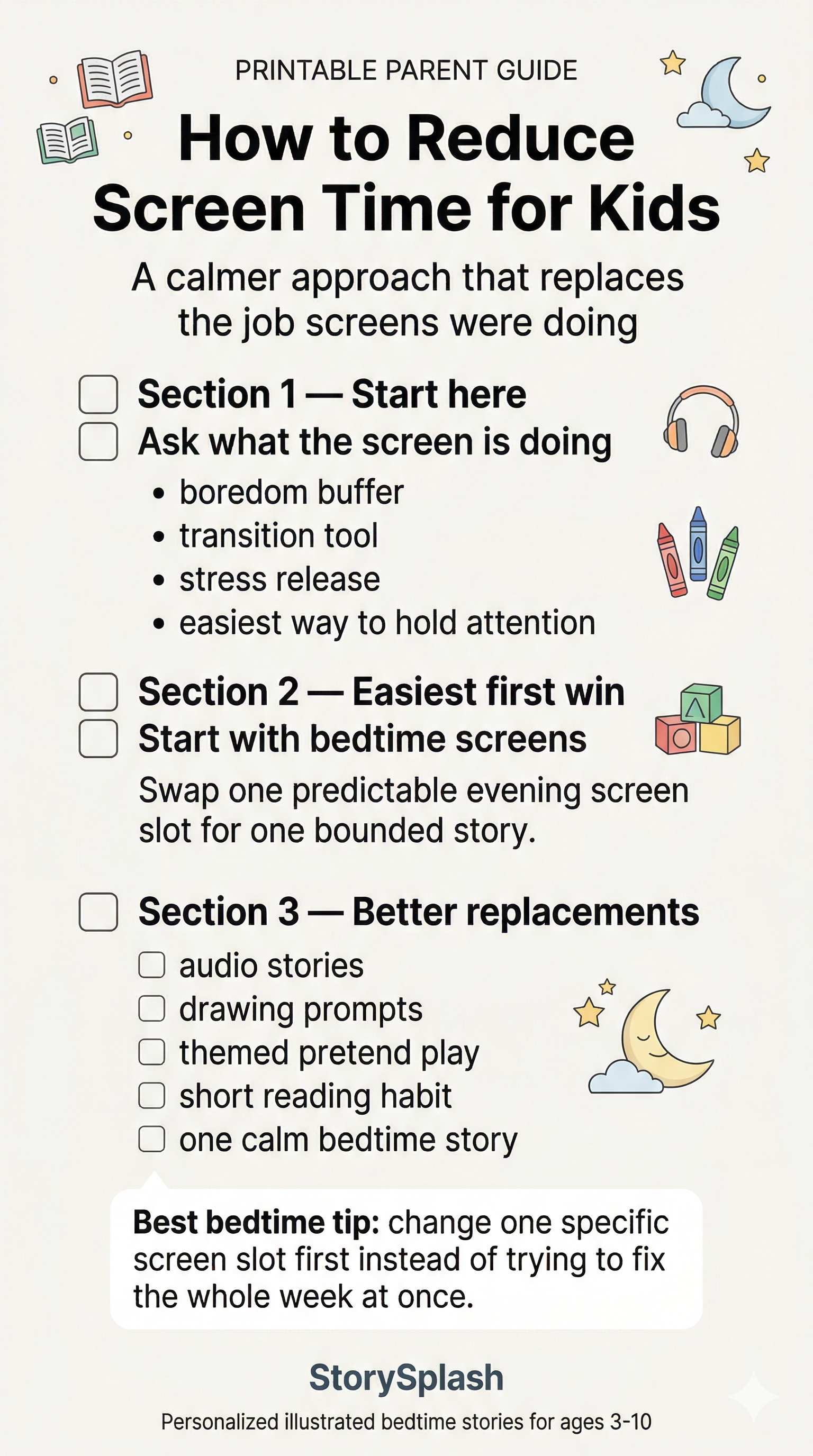
Most advice about reducing screen time sounds simple until it collides with real family life. A screen is often not just “time.” It is a transition tool, a boredom solution, a stress release, or the easiest way to hold a child’s attention while the day is still moving. That is why removing it without replacing its job usually fails.
Why “Just Turn It Off” Often Backfires
Screens are doing real work in many households. They keep a child occupied while dinner finishes. They fill the gap between school and evening. They give parents ten minutes to reset. When you take them away, the underlying need is still there.
That is why reducing screen time goes better when you ask what the screen is doing first. Is it helping your child decompress? Is it preventing boredom? Is it easing a transition? Once you know the function, you can find something else that solves the same problem.
Practical tip: Before changing anything, pick one screen window and write down what job it is doing in your home.
Start With the Easiest Slot: Bedtime Screens
Bedtime is often the easiest place to begin because the routine already gives you a clear substitution point. Instead of trying to reduce every screen in one week, change one predictable slot and keep the rest of family life stable.
This is where a bounded story works well. It gives the child engagement and novelty, but it also gives the brain a clean ending. That is very different from a game, an autoplay video, or anything else designed to keep going.
The distinction matters, and it is why screen time before bed for kids is more nuanced than most parents get told.
Practical tip: Frame the shift as “we are trying a different bedtime ending,” not “screens are bad now.”
What to Use Instead During the Day
Daytime screens can be harder because they are often filling boredom and energy needs at the same time. Generic advice like “just go play” usually does not work if the replacement is less engaging than the thing you removed.
Better replacements are adjacent to what your child already likes: audio stories, drawing prompts tied to a favorite world, building challenges, themed pretend play, or a short reading habit with a strong narrative hook.
The goal is not to make every alternative educational or worthy. The goal is to give your child something they can actually move toward.
Practical tip: Have the next activity visible before the screen ends. The transition is much easier when the replacement already exists in the room.
Build a Calmer Screen-Light Evening
Most families do not need perfection. They need a repeatable evening that feels easier than the current one. A predictable routine with a single story in the screen slot is one of the simplest places to start.
That is where StorySplash fits naturally. It gives parents a calmer replacement for passive evening screen use without requiring them to invent a new bedtime ritual from scratch.
Instead of handing over one more video or game, parents can generate a personalized illustrated story for their child in about two minutes, keep the story step inside the routine, and end the night with one clear stopping point. It is iOS-only, designed for ages 3-10, and built around the kind of bounded bedtime experience that helps the evening feel finished instead of abruptly interrupted.
Practical tip: Expect the first few nights of any routine change to be harder than the week after. That does not mean the change is failing. It usually means your child is adjusting.