Tell any parent you’re researching screen time and bedtime, and you’ll get the same tired response: screens are bad, full stop. The reality is more useful than that.
The problem isn’t usually the screen itself. It’s what’s happening on it — and whether there’s a clear ending.
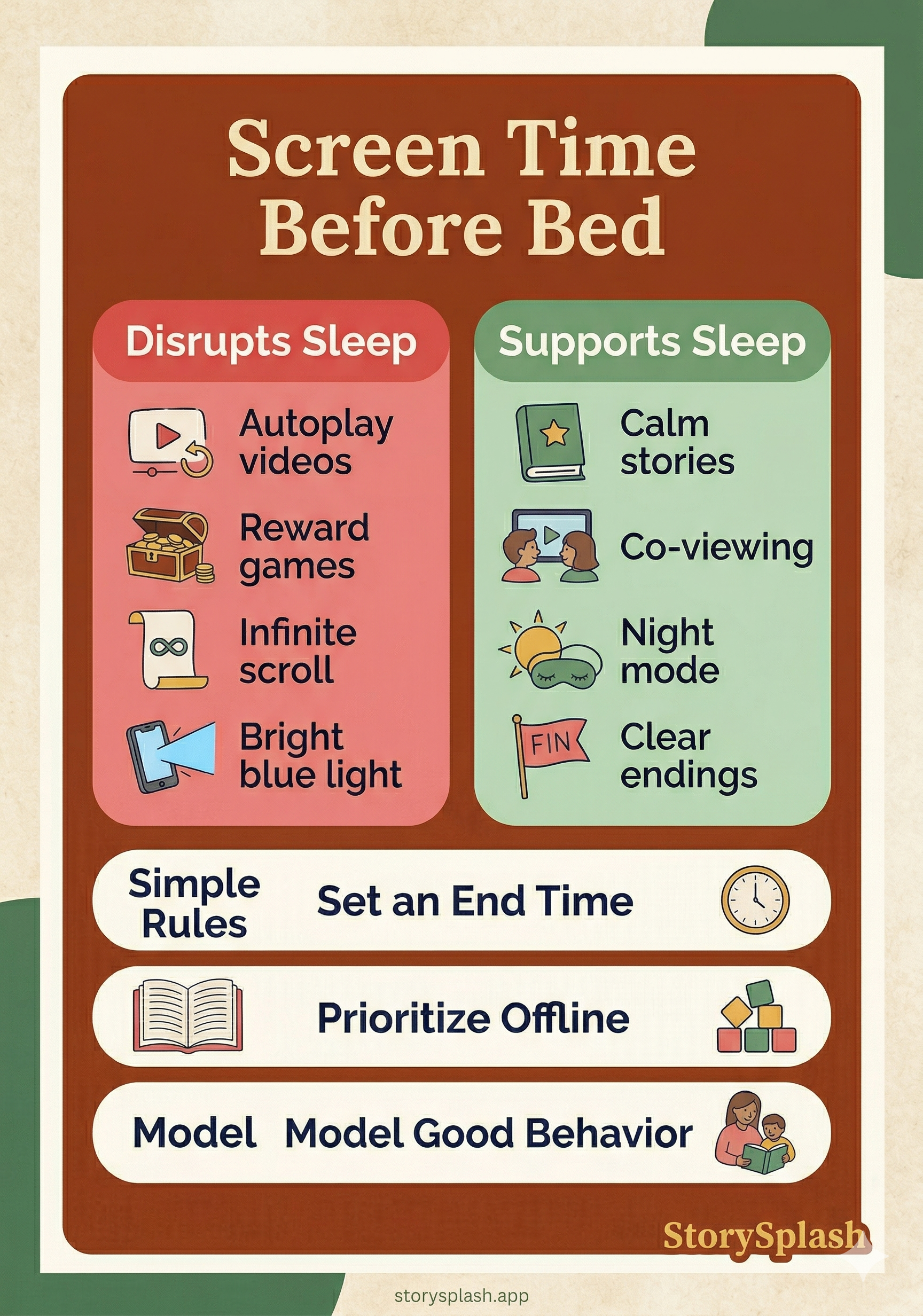
There’s also a free printable guide below if you want the quick version.
Why Some Screen Time Disrupts Sleep More Than Others
Blue light from screens does suppress melatonin, the hormone that signals to your child’s brain that it’s time to sleep. That part is real. But the more significant factor for most children is stimulation level, not light.
Fast-paced videos, games with unpredictable rewards, and autoplay content keep a child’s nervous system alert long after the device is put down. The brain has been trained to expect the next hit of novelty. Sleep doesn’t come easily from that state.
Calm, narrative content — a story with a beginning, middle, and end — does the opposite. It gives the brain something to process and resolve, then naturally winds down. The child finishes the story and feels complete rather than cut off mid-stimulation.
Practical tip: Enable night mode or warm display settings on any device used within an hour of bedtime. It helps, even if it doesn’t solve the full stimulation problem.
The Difference Between Winding Down and Zoning Out
There’s a version of bedtime screen use that genuinely prepares children for sleep, and it looks different from passive consumption. When a child is listening to a story, following a character they care about, or reading alongside a parent, their brain is engaged in a way that has a natural conclusion.
When a child is watching autoplay videos or playing a game, there’s no natural stopping point. Every ending is followed by an immediate start. The brain learns that stimulation is always available, which makes the transition to sleep harder.
The simplest test: does the screen activity have an end? If your child’s 8pm screen session finishes with a clear stopping point — the story is over, the lights go off — you’ve built a boundary into the activity itself. That’s the kind of screen time that works with bedtime rather than against it.
Practical tip: Choose content that ends by itself rather than content that requires you to interrupt it. The difference in your child’s reaction to lights-out will be noticeable.
What the Research Actually Says
The American Academy of Pediatrics updated its screen time guidance in 2016 specifically to move away from blanket minute-limits. Their current position focuses on content quality and co-viewing context, not raw screen time totals.
What the research consistently shows is that co-viewed, narrative content — particularly when a parent is present and engaged — produces measurably better outcomes than solo passive consumption of the same length. The parent’s presence transforms the experience: their reactions, questions, and pauses turn passive watching into active processing.
A bedtime story app used together at the end of the day sits firmly in the category of screen time the research supports. It’s time-bounded, narrative-based, and designed to end with a sleep cue, not a dopamine loop.
Practical tip: Sit with your child during the story, even briefly. Your presence makes it co-viewing, and co-viewing consistently outperforms solo consumption in development research.
Building a Screen Habit That Actually Supports Bedtime
The goal isn’t to eliminate screens at bedtime — it’s to replace the types of screen use that fight sleep with the type that supports it. That means:
- Swapping autoplay video or games for a single, bounded story
- Using night mode on the device
- Ending screen time with the same phrase every night so your child’s brain learns to associate it with sleep
- Keeping the routine consistent so the transition becomes automatic
StorySplash generates a calm, personalized illustrated story for your child in about two minutes — a genuinely useful swap for whatever was filling that slot before. It ends when the story ends, and your child goes to sleep knowing exactly how the night went.
Practical tip: If you’re replacing a screen habit, start the swap on a weekend night when you have more patience for the transition. Give it a week before evaluating.