When a parent tells me they’ve tried an AI bedtime story app and it didn’t work, the first thing I ask is: which one, and what did “didn’t work” mean? Because the category of “AI bedtime stories” contains apps that are fundamentally different from each other, some of which produce genuinely better bedtime engagement than almost anything else available, and some of which are essentially chatbot interfaces that have no business being in a bedtime routine.
Understanding the difference is more useful than a blanket verdict on whether “AI stories are good for children.” They can be, and many of them are. Here’s what to look for.
What AI Bedtime Story Apps Actually Do
This is worth explaining from first principles because a lot of what parents have heard about AI, the headlines, the news stories, the edge cases — doesn’t accurately describe what happens inside a well-designed children’s story app.
A good AI bedtime story app works roughly like this:
-
The parent (or child, depending on the app) inputs a set of preferences: the child’s name, perhaps their age, a story theme (forest, space, ocean), a character type (brave, curious, kind), and any other details the app collects.
-
These preferences are sent to a language model, which generates a story calibrated to the child’s age and the specified theme, original narrative, not a template with blank fields filled in.
-
The story passes through safety and quality checks before being shown.
-
The result is illustrated — either with AI-generated images or with a library of images matched to the story’s content.
-
The story is complete, it has a beginning, a middle, and an end, and it stops.
The key word in step 2 is “calibrated.” A good AI story app doesn’t just use the child’s name; it uses their age to set vocabulary complexity, their stated character trait to inform what the hero does, and their chosen world to create a setting that feels real. A 4-year-old who chose “brave explorer in a forest” gets a different story from a 9-year-old who chose the same thing — different vocabulary, different stakes, different emotional register.
This is what personalisation actually means, as opposed to a name swap in a template. Children notice the difference. The engagement drop-off you see with template-based apps — enthusiastic on night one, uninterested by night four — happens because the story stopped feeling personal after they worked out the template. Genuinely generated content doesn’t have this problem because every story is actually different.
Why Personalisation Matters More Than Library Size
One of the most common mistakes parents make when choosing a story app is prioritising library size. A thousand stories sounds better than a hundred stories, which sounds better than an infinite generator. But this is the wrong metric for bedtime.
Library size only matters if the child cares about the stories in the library. And children stop caring about the stories in a fixed library at surprisingly predictable rates:
- Very young children (2–3): they want the same few stories repeated, so library size is almost irrelevant
- Ages 4–5: they’ll engage with a large library for a few weeks and then settle into a small rotation of favourites
- Ages 6–8: they’ll exhaust their interest in a curated library within a few months
What children care about at every age is relevance. The story that’s about them, about their interests, about the kind of challenge they’re currently fascinated by, will always outperform the technically superior story about someone else.
This is why the AI generation model has a structural advantage over fixed libraries for the bedtime use case specifically. Not because AI stories are better written than human stories (they may not be), but because they can be more personally relevant, every time.
The parent who has tried a good AI story app and watched their child’s posture change when the story starts — watched them go from the pre-bed fidget to genuinely leaning in — understands this. The effect is reliable and measurable in living rooms across the world.
For more on why this happens developmentally, see our guide to personalised bedtime stories for kids.
How AI Story Generation Works: A Parent-Friendly Explanation
You don’t need to understand the technical architecture to use these apps well, but a basic mental model helps you evaluate what you’re looking at.
Large language models are trained on vast amounts of text and learn to predict what words follow what other words in what contexts. When you give one a prompt (“write a 500-word bedtime story for a 5-year-old named Ellie who chose to be a brave explorer in a forest with a friendly fox companion”), it generates text that is coherent, contextually appropriate, and calibrated to the specifications, because it has learned, from millions of examples, what such a story looks like.
The result isn’t retrieved from a database. It’s generated — assembled from the model’s understanding of story structure, age-appropriate vocabulary, narrative arc, and the specific parameters you provided. This is why two identical inputs will produce slightly different stories: there’s inherent randomness in which of the plausible word sequences the model follows.
For children’s story apps, good developers add several layers on top of the raw generation:
Age appropriateness filters: Vocabulary is constrained to what’s appropriate for the specified age. Story complexity — number of characters, narrative turns, emotional stakes — is calibrated to developmental stage.
Content safety: The generation is filtered against a list of content categories inappropriate for children. Reputable apps test these systems thoroughly.
Narrative quality controls: Good apps don’t just produce any coherent text; they produce text that follows proper story structure. Beginning, middle, end. A problem, an attempt, a resolution. An emotional arc. These controls make the difference between a generated story that feels like a story and one that feels like a random sequence of events.
Illustration matching: The most sophisticated apps generate or select images that match the specific story content, the same character looking consistent across multiple illustrations, the setting rendered in a style that suits the emotional tone.
Understanding these layers helps you evaluate what an app is actually offering. “AI-generated stories” can mean anything from a raw ChatGPT interface with a children’s prompt to a carefully engineered product with multiple quality layers. The quality difference is enormous.
What Makes a Good AI Bedtime Story App
Based on what we know about children’s sleep, story development, and personalisation research, here’s what to look for:
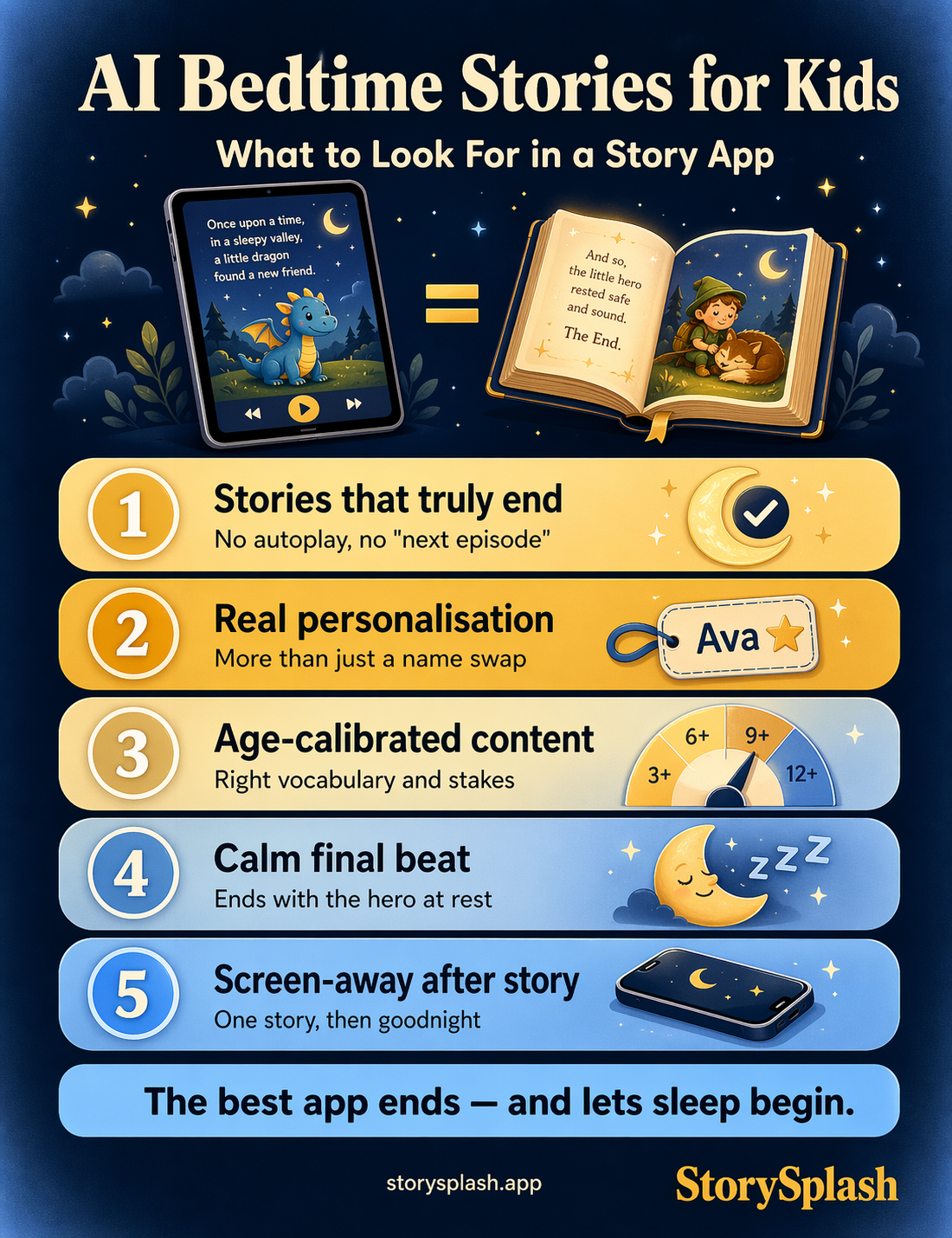
Stories That Are Genuinely Complete
This is the most important criterion and the one most often missed. A bedtime story needs to end. Not pause, not continue with another story, not offer a “what happens next” button — end. The child should reach a clear resolution, a safe-place landing, and a stopping point.
Apps that automatically queue the next story, or that present stories as episodes in an ongoing series with no clean break, actively undermine the sleep function of the bedtime story. The engine stays running.
Real Personalisation, Not a Name Swap
If you enter your child’s name and the word appears once in the first sentence and the story is otherwise generic, that’s a template. Real personalisation means the story’s character arc, world, and central challenge all reflect the inputs you gave.
A simple test: enter two different character traits — “curious” and “brave”, and see if the stories are actually different. If they’re nearly identical, the personalisation is superficial.
Age-Calibrated Content
The language, emotional stakes, and narrative complexity should match the child’s age. A well-calibrated story for a 4-year-old sounds different from a story for a 7-year-old, even if both are about the same theme. If the vocabulary is too advanced (the child seems confused or disengaged) or too simple (the child is clearly bored), the calibration is off.
A Calm Emotional Tone for the Final Story Beat
The last three sentences of a bedtime story are doing specific work: they’re signalling to the child’s nervous system that the adventure is over, everyone is safe, and it’s time to rest. The best AI story apps include this in their generation parameters, the story doesn’t just resolve, it resolves softly. “And as [name] curled up to sleep, the stars blinked one by one above the forest, and everything was still.”
If the app’s stories consistently end on high-energy or unresolved beats, it’s not designed for bedtime specifically.
No Open-Ended Interaction
The parent or child should be able to select parameters and receive a story, not engage in a back-and-forth conversation with an AI. Open-ended conversational AI is interesting for older children doing homework; it’s not appropriate for a bedtime wind-down for a 5-year-old.
Clear Screen Boundaries
The best apps make it easy to end the session. The story is complete; the app doesn’t push another one. The parent can put the device away immediately after the story without fighting a recommendation engine.
AI Bedtime Stories by Age
Ages 3–4: Simple Themes, Gentle Language, Lots of Illustrations
At three and four, children are engaging with story primarily through emotional response and visual imagination. The language should be simple enough that the child can follow without effort. The illustrations matter enormously, a rich, illustrated story has significantly more impact at this age than a text-only experience.
What to look for: Very simple story structure (one main character, one challenge, one resolution). Vocabulary well within age range. Full illustration. Short stories — 5 minutes maximum.
What to avoid: Stories with multiple characters to track, complex cause-and-effect, or any narrative ambiguity. Three-year-olds can’t hold unresolved story tension through the night.
Ages 5–7: Genuine Personalisation Begins to Pay Off
This is the age range where AI story apps show their biggest advantage over fixed-library competitors. Children at five to seven have a clear enough sense of self that a story genuinely about them, their name, their interests, a challenge that reflects their current world — produces qualitatively different engagement.
What to look for: True personalisation that goes beyond name swap. Stories where the hero’s specific trait (bravery, curiosity, kindness) is actually what solves the problem. Story length of 7–10 minutes. Illustrations that remain consistent, the same character looking the same across multiple images.
What to avoid: Template stories that use the name once and then proceed generically. Stories where the resolution happens through luck or external magic rather than something the hero does.
Ages 8–10: Richer Narrative, More Complexity
At eight to ten, children can follow longer stories with more characters, subplots, and moral complexity. An AI story for this age can have genuine stakes, a decision that costs something, a villain who has a comprehensible reason for their behaviour, an ending that isn’t perfectly happy.
What to look for: Longer story format (10–15 minutes). Stories where the hero makes a meaningful decision. Age-appropriate vocabulary that builds rather than talks down. Emotional complexity, the character can feel conflicting things.
What to avoid: Stories that are still calibrated for the 5-year-old emotional range, the same simplicity, the same stakes-free resolution, the same vocabulary. If the app isn’t adjusting for age, the older child will find it condescending.
Screen Time and Bedtime: Navigating the Tension
This is the question most parents ask first, and it’s worth addressing directly.
The research on screens before bed focuses primarily on two mechanisms:
- Blue light from screens suppresses melatonin production, delaying sleep onset
- Engaging, interactive screen content elevates arousal and makes the transition to sleep harder
Both of these concerns are real. Neither of them means that a 10-minute illustrated story on a tablet is equivalent to thirty minutes of social media.
The mitigation is practical:
- Use night mode or the warmest display setting on the device
- Set a strict time limit, the story is the session; when it ends, the screen goes away
- Don’t let the child hold the device themselves (adult control of the screen makes the ending clean)
- Put the device completely away after the story — in another room if possible
A parent who reads a story from a tablet in this way and then puts it away is not meaningfully different from a parent who reads from a book. The story is the thing. The medium is secondary.
For the broader question of how screen-based stories fit into a bedtime routine, see our guide on screen time before bed for kids.
How to Introduce AI Stories Into Your Bedtime Routine
The transition is most effective when the story slot is established before the AI app is introduced. Don’t start with the AI app and try to build a routine around it — build the routine first and drop the app into the existing story slot.
Specifically:
- Establish the rest of the routine: pajamas, teeth, bathroom, into bed
- Introduce the AI story as “tonight’s story” in the same slot where any story would go
- Do the setup (choosing the theme, the world, the hero’s name) together — make this part of the routine
- Listen to the story together
- Story ends; screen goes away; goodnight
The two-minute setup — choosing the world and character traits together — is worth preserving as a ritual. It’s the moment of anticipation that makes the story feel earned, and it gives the child genuine investment in what’s about to happen.
Children who’ve been through this process consistently report (in the manner of 5-year-olds) that they want “the story where I chose”, they reference the choice as part of the enjoyment, not just the story itself.
StorySplash: What It Does and How It Fits
StorySplash is an iOS app designed specifically for the bedtime use case, not a general AI tool repackaged for children.
The approach is built around genuine personalisation: you build a character profile for your child (name, age, character trait, favourite story world), and the app uses these inputs to generate an original illustrated story where your child is the actual protagonist. The illustrations are consistent, the same character appears throughout, and the story is calibrated to the child’s age in vocabulary, stakes, and emotional register.
Stories are designed to be 2–3 minutes for younger children and slightly longer for older ones. They end cleanly. There’s no recommendation engine pushing another story. The experience is a story, then done.
There’s also a daily free story that generates each morning, a story your child didn’t request but might enjoy, which many families use as a kind of “story of the day” during breakfast or after school rather than at bedtime.
For families who want to try it: the free trial includes two generated stories, which is enough to see whether the personalisation is working for your specific child. The iOS app is available at the App Store.
For a broader comparison of what’s available in the category, see our full roundup of best bedtime story apps for 2026.
What to Ask Before Downloading an AI Story App
Parents are reasonably sceptical of technology claims in the children’s space, and that scepticism serves them well here. Before downloading any AI bedtime story app, a few questions worth asking:
Who built this, and for whom? Some AI story apps are general-purpose AI tools with a children’s content filter added. Others are purpose-built for children’s bedtime specifically, with product decisions made around sleep outcomes rather than engagement metrics. The difference matters enormously. A product optimised for engagement will serve the parent poorly at 8:30pm.
Can I read the story before giving it to my child? Good children’s AI apps let parents preview generated content. The app should produce a complete story before presenting it to the child, and you should be able to read it first. Any app that streams content to a child in real time, without a preview step, is giving you less control than you should have.
Does the app have a clear stopping point? Navigate to the end of a story and see what happens. Does the app present another story automatically? Does it recommend content? Does it offer to continue the adventure? If yes to any of these, the app is optimised for engagement, not for sleep. A good bedtime app presents the story, finishes it, and then goes quiet.
What does the personalisation actually involve? Ask the app about personalisation and evaluate the answer. “Enter your child’s name” is not personalisation. “Enter your child’s name, age, personality trait, and preferred story world and we’ll use all of these to generate an original story” is closer to the right answer.
Is there a free trial? Any reputable app in this space should offer a meaningful free trial. For a bedtime story app specifically, “meaningful” means at least one full generated story, so you can evaluate the quality before committing.
The Research on Storytelling and Children’s Cognitive Development
The case for bedtime stories in general is extremely well-supported by research. For AI-generated and personalised stories specifically, the evidence is emerging but consistent with what we know from broader story research.
The most relevant findings:
Shared reading improves language development significantly and measurably. Children who are read to regularly develop larger vocabularies, stronger phonological awareness, and better reading comprehension than children who are not. This effect is strong enough that it’s used as a predictor of later academic performance.
Narrative exposure builds social cognition. The process of following a character’s motivations, predicting their decisions, and tracking their emotional arc is practice for the same cognitive processes used in real-world social understanding. Children who hear many stories tend to show better Theory of Mind development.
Personalisation increases engagement, and engagement improves retention. Content that feels personally relevant captures and holds attention more effectively. Children who are more attentive to a story retain it better, reference it more, and integrate its themes more deeply into their own understanding.
A consistent bedtime routine including story significantly improves sleep onset and sleep quality in children. The research on this is extensive and consistent: children with predictable bedtime routines fall asleep faster, wake less frequently, and accumulate more total sleep than children without them.
What this means for AI bedtime stories: the technology can amplify the established benefits of bedtime storytelling by delivering higher-engagement, more personally relevant content on a consistent nightly basis. It doesn’t replace the parental presence, the warmth of the routine, or the physical book. It adds a reliable source of personalised narrative that, used well, makes the story slot more effective.
Evaluating What You Actually See: A Practical Test Night
The best way to evaluate an AI bedtime story app is to use it for five nights in a row under realistic conditions and observe what happens.
Before the trial, establish what you’re looking for. Good outcomes:
- The child engages meaningfully with the story and stays settled
- Sleep onset after the story is similar to or shorter than typical
- The child asks for a specific character or world again the next night, suggesting the personalisation landed
- You, as the parent, can put the screen away after the story without a fight
Concerning outcomes:
- The child is more stimulated after the story than before it
- Sleep onset consistently takes longer after the story than on non-story nights
- The child treats the app as an entertainment product to be negotiated for more of
- The story content feels generic, even though you provided personalisation inputs
After five nights, you’ll have enough data to know whether this specific app is working for your specific child in your specific routine. No guide can substitute for this direct observation.
The Parent’s Role Doesn’t Diminish With an AI Story
A concern some parents raise about AI bedtime stories is that using a generated story removes the parent from the ritual. This misunderstands what a bedtime story is actually doing.
The bedtime story’s value is not primarily in who authored it. It’s in the shared experience: a parent and child, side by side, sharing a world together for ten minutes before sleep. The story is the occasion for that shared attention, not the substance of it. Whether the story came from a book purchased at a bookshop, a tale improvised by a grandparent, or a story generated by an app in response to a child’s choice of world and character trait, the quality of the shared experience is determined by how the parent shows up in the room.
Parents who use AI story apps well are fully present during the story. They ask questions after the setup choices are made. They read the story along with the child, or listen together, rather than starting the app and leaving the room. They have a conversation after the story about what happened, what the child noticed, what they would have done differently. The story is the starting point for connection, not a replacement for it.
If anything, a story that the child helped choose, and that features them specifically, creates more connection surface than a generic story. “You chose the ocean world tonight, and your character was curious, and look how it played out.” That’s a conversation that a generic story doesn’t make possible.
Integrating AI Stories With Physical Books
Parents sometimes approach AI bedtime stories as an either/or decision against physical books, and this creates an unnecessary tension. The two formats serve different functions and work well together.
Physical books offer things that generated stories can’t replicate. A specific, consistent object the child develops a relationship with. Illustrations that were crafted by a specific artist with a specific vision. The experience of holding the thing, turning the pages, returning to the same dog-eared favourite. These are real and valuable.
AI-generated stories offer things that fixed physical books can’t. Infinite novelty. Genuine personalisation to the child’s current interests and age. A story about this child, tonight, not a generic protagonist. The ability to give the child a story that reflects exactly what they’re excited about this week, not what a publishing committee decided would be popular two years ago.
The most effective approach for most families uses both. Physical books for the stories worth returning to, for building a library of favourites, for the tactile reading experience. AI-generated stories for on-demand new content, for the nights when a specific world or character is requested that no book in the house provides, for the engagement boost that personalisation delivers.
This isn’t a compromise position. It’s a genuinely complementary approach that gives children more of what makes stories valuable.
The Future of Bedtime Stories
It’s worth stepping back from the practical questions to notice what’s actually new here.
For the entire history of human storytelling, a personalised story, a story made specifically for one child, featuring that child, in their world, about their challenges — required a skilled storyteller in the room. Grandparents. Parents who’d been doing it for years. Professional storytellers on special occasions. It was labour-intensive, capacity-constrained, and impossible to replicate.
AI story generation makes personalised stories available on any night, at any time, for any family, regardless of the parent’s creative energy at 8:30pm. That’s not a small thing. It’s a genuinely significant change in what’s possible at bedtime.
The technology doesn’t replace the parent in the room, the warmth of the bedtime ritual, the physical presence, the familiar voice reading along, the conversation after. It replaces the work of constructing an original story from scratch on a Tuesday night when everyone is exhausted.
That’s a reasonable trade, and for many families, it’s what makes the personalised story slot sustainable rather than aspirational.