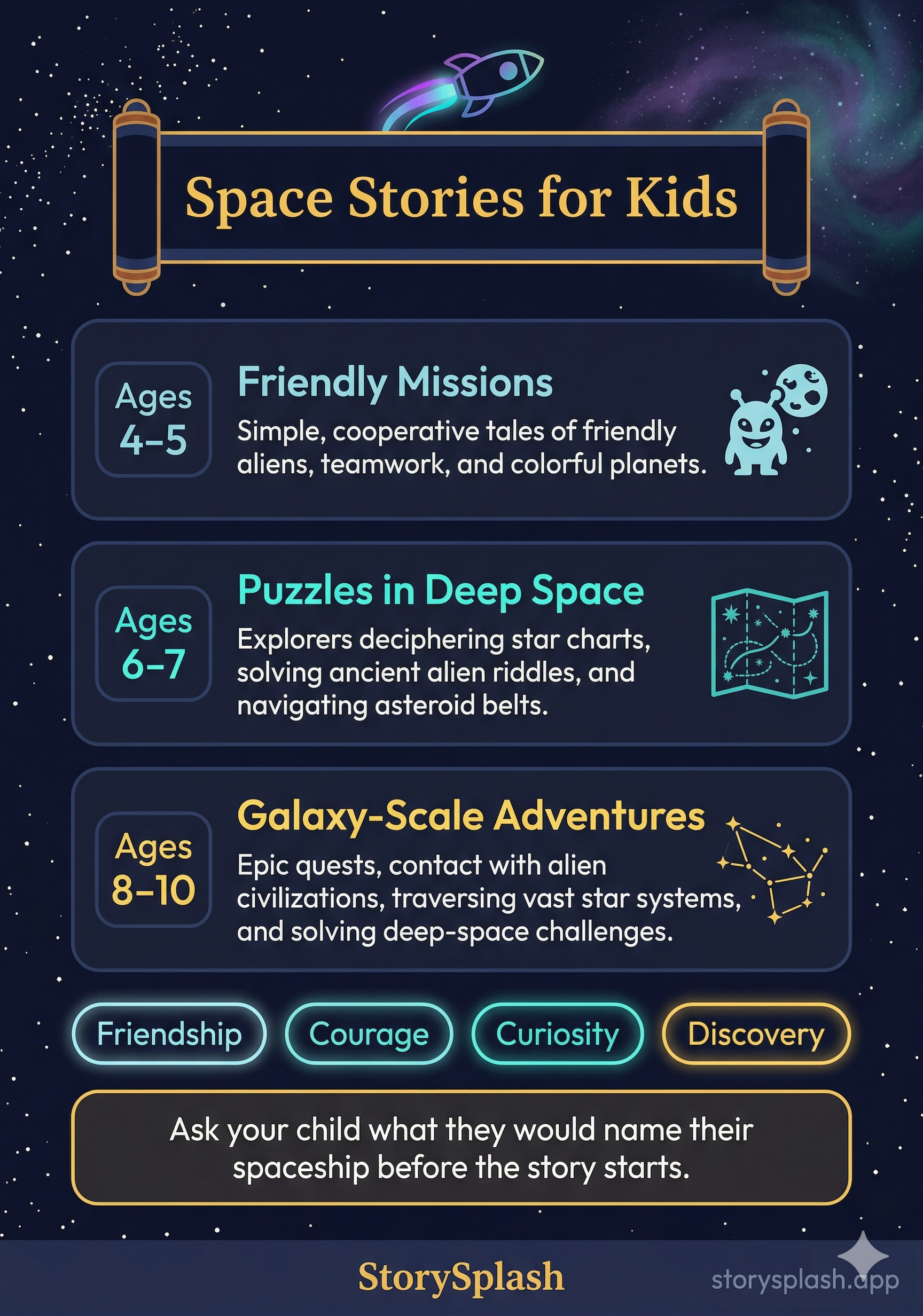
The moment you mention rockets, stars, or alien planets, most children aged 4 and up are immediately alert. Space has a particular pull at bedtime: it is vast, mysterious, and full of questions that feel impossible to exhaust — which makes it the perfect setting for a story that gently winds a child’s imagination down into sleep.
Here is what makes space stories work so well, an age-by-age breakdown, and a free printable below.
Why Outer Space Captivates Children at Bedtime
Space stories work because they tap into something children already feel: the world is enormous and they are small in it. Unlike scary themes, outer space is mysterious without being threatening. Stars do not chase you. Planets are wondrous, not dangerous. For a child lying in the dark, a story about drifting through stars maps perfectly onto the quiet feeling of being carried toward sleep.
There is also the wonder factor. Space answers questions children already ask: what is out there? Are we alone? What would it feel like to float? A good space story gives their imagination room to explore those questions safely, from their own bed.
Age-by-Age Guide to Space Stories
Ages 4–5: Keep the universe small and friendly. A single planet, a helpful alien, and a short mission work best. Children this age want to feel brave and capable, not overwhelmed by scale. A story where your child pilots a little rocket to bring something back for a lonely star-creature is exactly the right scope.
Ages 6–7: Add a problem to solve. The spaceship has a navigation error. The star map leads somewhere unexpected. A mysterious signal needs decoding. Children this age love a puzzle inside a story, and space gives you infinite room for interesting problems that their hero can solve.
Ages 8–10: These children can handle complexity. A crew working together, an unknown galaxy, a moral question about discovery — space adventures at this age can carry real weight. Length can stretch to ten pages or more, and the emotional core of the story can be richer.
Practical tip: Match the scope of the adventure to your child’s age. A five-year-old lost in an infinite galaxy feels frightened. A five-year-old rescuing a small space creature feels heroic. The difference is entirely in scale.
Story Themes That Work Brilliantly in Space
The setting of outer space pairs beautifully with several underlying story themes.
Friendship: Meeting someone completely different — an alien whose world is nothing like Earth — but finding they share the same longing for home. This is one of the most emotionally resonant combinations for children ages 6–9.
Courage: Facing the unknown far from home. The vastness of space makes a child’s bravery feel enormous by comparison. Small hero, enormous universe, and the child still finds their way.
Curiosity: Discovery-based stories where the goal is understanding rather than winning. These land particularly well with children who ask a lot of “why” questions before bed. The story gives their curiosity a shape to follow, then a resolution to rest on.
Practical tip: Ask your child what they would name their spaceship before the story starts. That one decision locks them in as the hero before the first sentence.
Keeping the Same Explorer Across Stories
One thing that makes space stories stay in a child’s memory: continuity. The same astronaut hero returning in a new adventure — different planet, different challenge, same brave character — builds something a single story cannot. Your child starts asking what happens next before you have even started. That investment is what produces the attention at 8:30pm that every parent is looking for.
Don’t have time to tell this story tonight? StorySplash generates it for you in 30 seconds.